Cairo airport layover itinerary: Giza pyramids only
A layover is not a free day in Cairo
A long connection at Cairo International Airport (CAI) is not the same trip as a proper one day in Cairo. A visitor sleeping at a hotel in the city or in Giza can weigh downtown Cairo against the pyramids and decide on the day. A transit passenger cannot. The only variable that matters here is the safety margin before the return flight, and that margin is set by two airport transfers of 60-90 minutes each, not by how much you’d like to see. This itinerary assumes one thing only: a single block of time between two flights, spent entirely on the Giza plateau, with nothing else realistically in reach.
Downtown Cairo, Islamic Cairo, and Coptic Cairo are out of scope for a layover of this kind. They sit further from the airport than Giza, and adding them turns a tight but workable window into a missed flight. If you have more than a single day, look at proper city itineraries instead — this page is specifically for the case where a flight schedule, not a hotel booking, is deciding your day.
Mobility is worth flagging before you book, not after you land. The plateau involves uneven sand and stone underfoot, and moving between viewpoints means short walks; a layover leaves no slack to adapt on the fly if a wheelchair or limited mobility changes the pace an operator can realistically manage. If this applies to you, say so at booking and read Giza pyramids accessibility before committing to the timing below, since a slower visit eats into the same fixed window everyone else is working with.
Day 1: the whole trip, start to finish
Land and clear immigration. Budget more time than you think for passport control and baggage claim at CAI, especially at peak hours. A driver arranged in advance — through your airline, a hotel day-room package, or a private half-day pyramids tour built for transit passengers — should be waiting in the arrivals hall with your name, not something you arrange on the spot.
Transfer to Giza: 60-90 minutes. This is the number that governs everything else. CAI sits in Heliopolis, in the northeast of the city; the pyramids are on the western edge of Giza. There is no shortcut across Cairo’s traffic, which stays heavy through most of the day regardless of the hour you land. A driver who does this route regularly will know which crossings are currently worse and adjust, but they cannot make the distance shorter. Treat 60-90 minutes each way as the baseline, not the best case.
At the plateau: roughly two hours. This is enough to see the three pyramids — Khufu (the Great Pyramid, the only ancient wonder of the world still standing), Khafre, and Menkaure — plus the Great Sphinx, and to get a small number of decent photo stops. It is not enough to also queue for pyramid interior access, which runs on its own separate ticket and line and can eat 45 minutes or more on its own. If seeing inside a pyramid matters to you specifically, say so when booking and expect it to replace something else, not to be added for free.
Return transfer: another 60-90 minutes, plus airport check-in and security before boarding. Build this leg with the same respect as the outbound one — Cairo traffic does not improve in the afternoon just because your flight is at stake.
Put together, a comfortable version of this day needs roughly 6-7 hours minimum from landing to your next boarding call, and more is better. Anything shorter turns the pyramids into a rushed drive-by, and anything close to the minimum leaves no room for a delayed flight, a slow immigration queue, or heavier-than-usual traffic.
If your layover sits on the short end
Some transit passengers have closer to 6 hours than 8, and the honest arbitration in that case is not which sites to add — there is nothing to add on a layover — but how much of the plateau visit to trim. The first thing to cut is not the transfer, which is fixed regardless of how the time in Giza is spent; it is the on-site walking loop. A driver working this route routinely can offer a tighter version: stop at the two or three viewpoints that matter most, skip the longer walk toward the Sphinx enclosure gate, and keep photo stops brief rather than leisurely.
That kind of trim shaves perhaps 20-30 minutes off the plateau time without touching either transfer, which is the one part of the day a short layover genuinely cannot afford to compress. If the arithmetic still doesn’t work once immigration, both transfers, and a realistic check-in buffer are subtracted, the honest call is to skip the excursion rather than book a driver and risk cancelling from the road. A missed flight costs far more than a pyramid view postponed to a future trip.
The transfer is the itinerary, not a detail
On a normal Cairo trip, the drive from a hotel to Giza is a footnote. On a layover, it is the largest single constraint you have, twice over. A private driver who specializes in airport transfers and layover pickups will plan the whole loop around your flight times, not the other way round — meeting you at arrivals with a name board, confirming your outbound flight number before leaving Giza, and building the return with a buffer for Cairo’s traffic rather than an optimistic estimate.
Do not attempt this with public transport or an improvised taxi under time pressure. Cairo’s metro does not run to the pyramid entrances, and flagging transport on the street with a flight to catch adds exactly the kind of uncertainty a layover cannot absorb. A pre-booked driver or a tour built specifically for transit passengers is the only sensible way to do this.
What fits on the plateau, and what doesn’t
The Giza plateau itself — Khufu, Khafre, Menkaure, and the Great Sphinx — is a compact, walkable site, and it is genuinely the reason to attempt a layover excursion at all. A guide or driver who does this route often will take you to the standard viewpoints efficiently and know where crowds and touts tend to cluster.
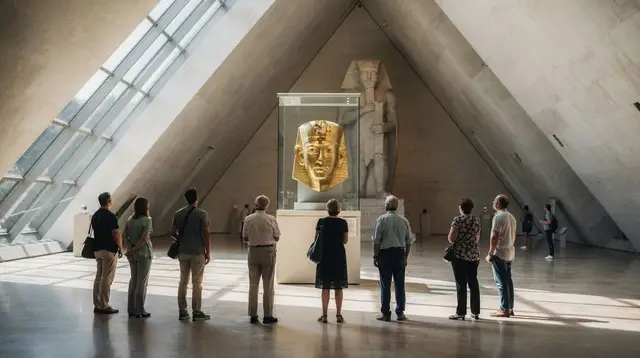
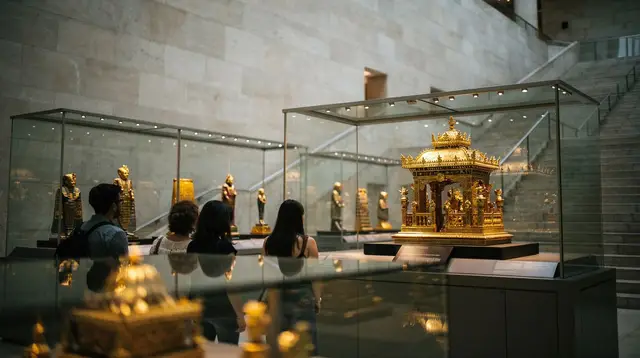
The Grand Egyptian Museum (GEM), officially opened on 1 November 2025, sits right next to the plateau, which makes it tempting to add. In practice, a proper museum visit needs at least two to three unhurried hours on top of the pyramids and both transfers — more than most layovers can spare. If your connection is unusually long and your driver confirms there is real time left after Giza, it can work as a bonus stop. Otherwise, treat the choice between the two the way this comparison of the GEM against the Egyptian Museum at Tahrir frames it for a full day, and plan to return for the museum on a future trip rather than rushing it now.
Camel or horse rides at the plateau, the evening sound-and-light show, and anywhere further out — Saqqara, downtown Cairo, Islamic Cairo — are off the table entirely for this format. A same-day comparison of Giza against Saqqara is useful reading before a longer Cairo stay, but not for a layover: there simply isn’t a version of this day that adds a second site without risking the flight.
Booking the right tour for a transit window
Not every Giza tour is built for a hard flight deadline. A standard group tour departs from a downtown hotel on its own schedule and may not accommodate an airport pickup and drop-off, or a fixed return time. For a layover specifically, look for a private, airport-focused option:
A private half-day tour to the Giza pyramids is the most direct fit for a layover — it’s built around a set block of hours rather than a fixed departure point, which a driver can adapt to your flight times.
If you’d rather book entry separately and arrange your own driver, a QR code entry ticket for the Giza pyramids skips the on-site ticket line, which matters more on a layover than on any other kind of visit.
Travelers who prefer a scheduled group departure and can confirm it fits their landing and boarding times can also consider a group tour to the Giza pyramids and Sphinx, though always confirm the pickup point and duration against your actual connection before booking.
Whichever option you choose, message the operator directly with your flight numbers and ask them to confirm, in writing, that the itinerary and pickup/drop-off times work for a layover — not just that Giza is one of the stops.
What surprises first-time layover visitors
Two things tend to catch layover travelers off guard. The first is the density of touts and unofficial guides near the plateau entrance, who approach quickly and can be persistent; a driver or guide who works transit passengers regularly will usually run interference, but expect to say no more than once. Reading Cairo tourist scams to avoid before landing is worth it if Giza is your first stop in Egypt.
The second is heat and glare with essentially no shade at the plateau itself — there is nowhere to retreat between viewpoints. That matters more on a tight schedule than on a leisurely visit, since there’s no slack to wait out the worst of the sun or to slow down if the heat is heavier than expected. Neither issue is dangerous on its own, but both eat into a window that was already tight before you left the airport, which is why the transfer times in this itinerary carry no spare margin for either.
Money, entry, and timing details that matter here
You’ll need Egyptian pounds (EGP) for small purchases and tips at the plateau; airport currency counters and ATMs handle this, though rates and fees vary, so check current terms before exchanging. Most nationalities still need a visa to leave the airport, whether an e-Visa arranged in advance or visa on arrival for eligible passports — this is not a visa-free transit exception, so confirm your specific requirement before you land. Cairo runs on UTC+2, with daylight saving (UTC+3) applied again since 2023, which is worth double-checking against your connection time if you’re booking a fixed pickup slot.
Heat is a real planning factor from June to August, when midday temperatures often pass 35°C; if your layover falls in these months, ask whether an early-morning or a later-afternoon slot is possible rather than the hottest midday hours. October to April is milder and more comfortable for a rushed outdoor visit, though winter mornings can be cool enough to want a layer.
What to skip entirely on this itinerary
Skip the pyramid interior queue unless your driver confirms real spare time — it is a separate ticket and a separate line, and it is the single easiest way to turn a tight layover into a missed connection. Skip any plan that pairs Giza with downtown Cairo, Islamic Cairo, or Saqqara; these belong to a proper one-day Cairo itinerary or longer stay, not a layover. Skip improvised transport of any kind, and skip tours that don’t explicitly confirm airport pickup and a return timed to your flight. If you’re unsure whether your connection is long enough to attempt any of this safely, the honest answer is often to stay airside and plan a proper Cairo trip another time — the pyramids will still be there.
Is the Giza plateau accessible for travelers with mobility needs on a layover?
It can be, but a layover removes the slack that makes a slower visit workable elsewhere. The ground is uneven sand and stone, and reaching each viewpoint involves a short walk. If mobility is a factor, flag it when booking so the driver can plan a tighter route in advance, and check current accessibility guidance before relying on the timing given above — a slower pace on the plateau still has to fit inside the same fixed window as everyone else’s visit.
What’s the most common regret from a rushed layover pyramid visit?
Underestimating the touts near the plateau entrance and the lack of shade once there. Both are manageable with a driver or guide who works transit passengers regularly, but they slow down a schedule that already has no spare time built in, which is why this itinerary treats the transfer windows as fixed rather than flexible.
Cairo trip planning and itinerary tours on GetYourGuide
Verified deep-linked GetYourGuide tours. Book through these links and we earn a small commission at no cost to you.
GetYourGuide does not provide a product photo for this activity — the image shows the meeting point, photographed by us.