Giza pyramids tours: visiting Khufu, Khafre and Menkaure
What does a Giza pyramids tour actually include?
The Giza plateau holds three pyramids, Khufu, Khafre and Menkaure, plus the Great Sphinx. A standard tour covers the plateau and viewpoints, sometimes with camel or horse time and photo stops. The Grand Egyptian Museum next door is a separate outing, not part of a pyramids tour.
What is actually on the Giza plateau
The Giza plateau holds three pyramids: Khufu, Khafre and Menkaure. The Pyramid of Khufu, also called the Great Pyramid, is the largest of the three and the only surviving wonder of the ancient world’s seven. Khafre’s pyramid sits slightly higher on the plateau and still carries a visible cap of its original smooth casing stone near the top. Menkaure’s pyramid is the smallest of the three, with three smaller queen pyramids beside it. Next to Khafre’s causeway stands the Great Sphinx, a limestone figure with a lion’s body and a human head, facing east.
That is the full list. Some visitors expect two pyramids, or remember four from a half-remembered photo; the plateau has three main pyramids and the Sphinx, and any guide or listing that says otherwise has the count wrong.
The plateau is classified by UNESCO as part of “Memphis and its Necropolis — the Pyramid Fields from Giza to Dahshur”, inscribed in 1979. That single World Heritage listing covers Giza, Saqqara and Dahshur together, which is one reason itineraries often pair them, even though each site is its own visit.
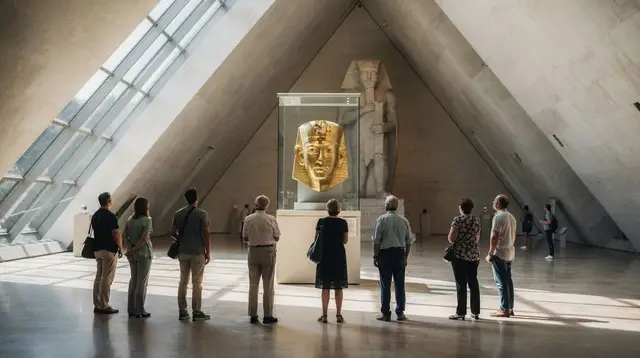
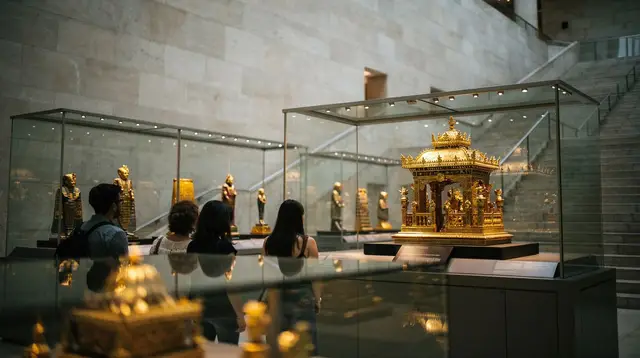
One thing this guide does not cover in depth: the Grand Egyptian Museum (GEM), which sits right beside the plateau and officially opened on 1 November 2025 with the complete Tutankhamun collection. The GEM is a museum visit, not a plateau visit, and deserves its own planning and ticket. For that, see Grand Egyptian Museum tours. This page stays on the pyramids, the Sphinx and the plateau itself.
What often surprises first-time visitors is how close the pyramids sit to the city rather than to open desert. Giza is at the western edge of Cairo’s urban sprawl, and from several of the plateau’s closer viewpoints, apartment blocks and the skyline sit directly behind the monuments. Photographs that show the pyramids rising out of empty sand are usually taken from specific angles, or from further back at the panorama viewpoint, where the frame can be arranged to exclude the city. Neither view is more “real” than the other; it is worth knowing in advance which one you will actually get from a standard tour stop, so the site does not feel like a letdown next to the postcard image.
Booking a Giza pyramids tour
a small-group half-day tour of the pyramids and the Great Sphinx is the most common way to see the plateau, usually with hotel pickup from central Cairo or Giza. It covers the three pyramids from the outside, a stop at the panoramic viewpoint, and time at the Sphinx.
For travellers who want to skip the queue logistics and book the plateau ticket ahead of time, a QR-code entry ticket for the pyramids avoids the on-site ticket window, which can be slow at busy times of day.
If your schedule is tight, a private half-day trip to the Giza pyramids with your own driver and guide gives more control over pacing than a fixed-departure group tour, at a higher price.
Camel and horse rides around the plateau are sold separately from the entry ticket. A camel ride at the pyramids around sunset or sunrise adds a different vantage point over the site, away from the main viewpoint crowds, though it is an add-on rather than a substitute for walking the plateau itself.
Compare group and private formats for the wider area, not just Giza, in private vs group tours in Cairo.
How long to plan for
Two to four hours is realistic for the plateau itself: the three pyramids, the main viewpoint over the whole site, and the Great Sphinx. A camel or horse ride adds roughly 30 to 60 minutes. Going inside a pyramid chamber, where available, adds queuing time and is not always included in a standard ticket or tour, so check what is covered before you book. For a fuller sense of pacing across a Cairo stay, see how many days in Cairo.
Getting to Giza takes longer than the visit itself sometimes suggests. From a central Cairo hotel, allow 45 to 90 minutes each way depending on traffic, which runs heavy for most of the day. From Cairo International Airport, allow 60 to 90 minutes to reach Giza. Staying at a hotel in Giza facing the plateau removes most of that transfer time, which matters if you want an early start before the heat and the crowds build. For transfer planning, see Cairo airport transfers and Cairo traffic and realistic travel times.
Early morning is the better window in the warmer months. Between June and August, temperatures often pass 35°C by midday, and the plateau has almost no shade, so an opening-time visit is more comfortable than a midday one. Between October and April, days are milder and an afternoon visit is more workable. See Cairo in summer and best time to visit Cairo for seasonal detail.
Crowds follow a predictable pattern that is worth planning around separately from the heat. The plateau gates open early, and the first hour after opening is consistently the quietest, both at the viewpoints and around the Sphinx. From mid-morning onward, coach groups from central Cairo hotels and, on days when a cruise ship is in port, larger organised groups converge on the same handful of viewpoints, and the panorama area in particular fills with parked vehicles, camel handlers and vendors working the crowd. None of this closes the site or changes the ticket price, but it does change how much space you get to actually look at the monuments rather than move around other groups. If a tour operator offers a choice of start time, an early slot is worth taking over a later one for this reason alone, independent of temperature.
If you only have half a day at Giza, it helps to decide in advance what you actually want rather than try to fit everything in. A slow walk between the three pyramids and the Sphinx, with time to stand and look rather than only photograph, covers the core of the site in under two hours. Adding the panorama viewpoint, a camel or horse ride and unhurried time at the Sphinx can fill the same half-day comfortably. Trying to also fit Saqqara, the GEM or a Nile felucca sunset onto that same afternoon is usually where a relaxed half-day turns into a rushed one; pick one addition rather than three, and treat the rest as reasons to plan a longer stay or a return visit.
The Great Sphinx
The Sphinx sits along the causeway leading to Khafre’s pyramid, facing east toward the Nile valley. It is smaller in person than photographs sometimes suggest, and the viewing area in front of it gets crowded, particularly mid-morning. A short visit, 20 to 30 minutes, covers it well; there is no separate ticket for the Sphinx beyond the general plateau entry.
Giza sound and light show, in the evening
The plateau runs an evening sound and light show, with the pyramids and Sphinx lit and narrated. It is a separate evening outing from a daytime plateau visit, on its own ticket and schedule, and it shows the monuments illuminated rather than up close in daylight. It suits travellers with a free evening in Giza rather than as a stand-in for the daytime visit; the daytime visit is where you actually walk the plateau. Details and schedules: Giza sound and light show.
Giza plateau vs the Grand Egyptian Museum
These are two different outings that happen to sit next to each other. The plateau is the outdoor archaeological site: the three pyramids, the Sphinx, the desert setting. The GEM is an indoor museum holding, among other collections, the full set of Tutankhamun artefacts, and it opened officially on 1 November 2025. Some travellers try to fit both into one day; it is physically possible given the short distance between them, but the museum alone can take three or more hours to see properly, so treat it as its own half-day rather than an extension of the plateau visit. A side-by-side comparison of what each covers: Grand Egyptian Museum vs Egyptian Museum Tahrir and the museum-specific guide at Grand Egyptian Museum tours.
Combining Giza with Saqqara
Giza and Saqqara belong to the same UNESCO listing, and some private-driver itineraries combine both, along with Dahshur and Memphis, in a single long day starting early. It is workable, but it is a full day rather than a quick add-on, given the driving between sites and the size of each one. If a two-site day interests you, the fuller plan for pairing them, including Dahshur’s Bent and Red Pyramids and the Memphis open-air site, sits in Saqqara, Memphis and Dahshur tours; this page focuses on Giza on its own.
Getting there and getting around
Most visitors reach Giza by private driver or a booked tour with hotel pickup, which is the norm for day excursions in and around Cairo. Ride apps such as Uber and Careem also run to Giza and are commonly used for one-way transfers. Public transport does not reach the plateau directly. See Uber and Careem in Cairo, hiring a private driver in Cairo and how to get to the Giza pyramids for the options in more detail.
Once dropped off, the plateau is walkable between the three pyramids and the Sphinx, though the ground is sand and gravel and distances between the pyramids are longer than they look from the road. Comfortable shoes matter more than any other packing decision for this visit; see what to pack for Cairo.
Tickets, touts and other practical notes
Entry tickets are sold at the plateau gate, with the QR-code option above letting you skip that queue. Prices are not fixed here since they change; check the booking page for the current rate rather than relying on a number printed elsewhere. The same applies to any camel, horse or quad-bike offer made informally at the site: agree a price before you get on, and expect persistent offers around the car park and viewpoint areas. For a fuller rundown of common pressure tactics at the plateau, see how to avoid touts at the pyramids and Cairo tourist scams to avoid.
Cash in Egyptian pounds is worth carrying for small purchases and tips at the site; cards are not always practical for informal vendors on the plateau. See money, cards and ATMs in Cairo and baksheesh and tipping in Egypt.
If you are visiting with children, the walking distances and heat are the main planning factors rather than the site itself; see Giza pyramids with kids. For travellers with mobility needs, some of the plateau’s viewpoints are reachable by vehicle, but the ground around the monuments is uneven sand and gravel; see Giza pyramids accessibility.
Handheld photography with a phone or a standard camera is unrestricted across the plateau and needs no separate ticket. Tripods, professional-looking equipment and any drone use are a different matter: these generally require a permit arranged in advance rather than something bought at the gate on the day, and rules on this have changed before without much notice. Most visitors never need to think about it, but anyone travelling with dedicated camera gear or planning to fly a drone over the plateau should check current requirements before the trip rather than assume a standard entry ticket covers it.
Giza pyramids at a glance
| Monument | Built for | Notable point |
|---|---|---|
| Pyramid of Khufu | Khufu | Largest of the three; the Great Pyramid, sole surviving ancient wonder |
| Pyramid of Khafre | Khafre | Retains part of its original casing stone near the summit |
| Pyramid of Menkaure | Menkaure | Smallest of the three main pyramids, with satellite queen pyramids |
| Great Sphinx | — | Limestone figure on Khafre’s causeway, facing east |
Frequently asked questions about visiting the Giza pyramids
How many pyramids are there at Giza?
Three: Khufu, Khafre and Menkaure, plus the Great Sphinx nearby. Listings or itineraries that mention two or four pyramids are describing the site incorrectly.
Is the Grand Egyptian Museum part of a Giza pyramids tour?
Not usually. It is next door but runs as a separate visit with its own ticket, and it opened officially on 1 November 2025. Book it separately if you want to see it.
Can you go inside the pyramids?
Access to interior chambers is sold separately with limited daily capacity and is not guaranteed on a standard group tour. Confirm inclusion before booking if this matters to you.
Is the Giza sound and light show worth it?
It is an evening add-on that lights up the monuments after dark, distinct from a daytime visit. Worth it with a spare evening; not a substitute for seeing the plateau in daylight.
Can you combine Giza with Saqqara in one day?
Yes, with an early-starting private driver, since both sites sit within the same wider necropolis. It makes for a full day rather than a light add-on.
How much time do you need at the Giza plateau?
Two to four hours for the three pyramids, the viewpoint and the Sphinx. Add time for a camel or horse ride, or for the evening show if staying on.
Where do Giza pyramids tours usually start from?
Mostly hotel pickups in central Cairo, Zamalek or Giza. A Giza hotel cuts the 45-to-90-minute drive from central Cairo down considerably.
Is the panorama viewpoint included in a Giza tour?
Not always. Some tours include a stop at the panoramic viewpoint south of the pyramids as part of the itinerary, while others treat it as an optional add-on reached by camel, horse or vehicle. Check the specific tour description rather than assuming it is covered.
Do the pyramids sit in open desert or near the city?
Both. Giza sits at the western edge of Cairo’s urban sprawl, so several closer viewpoints on the plateau show apartment blocks and the skyline directly behind the monuments. The open desert stretches further west, away from those vantage points.
Giza pyramids and Sphinx tours on GetYourGuide
Verified deep-linked GetYourGuide tours. Book through these links and we earn a small commission at no cost to you.
GetYourGuide does not provide a product photo for this activity — the image shows the meeting point, photographed by us.