Self-guided visit of the Giza plateau
Can you visit the Giza pyramids without a guided tour?
Yes. The plateau is open to independent visitors with a standard entry ticket, and the layout is straightforward enough to walk on your own. Arrive at opening time, plan on two to three hours on foot, and expect frequent offers for camel rides, photos and unofficial guiding along the way.
Walking the plateau on your own terms
Getting to Giza from a Cairo or Gizeh hotel is a separate question, covered in our guide to Cairo traffic and realistic travel times. This page starts where that one ends: you have a ticket in hand and you are standing at the plateau gate. What happens next, on foot, for the next two to three hours, is what most first-time visitors underestimate.
A self-guided visit works well here. The site is compact enough to navigate without a fixed itinerary, the three pyramids and the Great Sphinx are all visible from most points on the plateau, and nothing requires a booked slot beyond the entry ticket itself. What catches people off guard is not the layout — it is the heat, the walking distance between points, and the steady stream of people trying to sell something along the way.
The logical order: Khufu, Khafre, Menkaure, then the Sphinx
The plateau sits on a gentle rise, with the pyramids arranged roughly northeast to southwest and the Great Sphinx enclosure lower down, closer to the main visitor entrance most people use.
The Great Pyramid of Khufu is the largest and the one nearest the main gate for most arrivals, so it makes sense as a first stop. It is the only one of the ancient world’s Seven Wonders still standing, and its scale is easiest to appreciate up close before you have seen the other two. From there, a walk southwest brings you to the Pyramid of Khafre, slightly smaller than Khufu but appearing taller from some angles because it sits on higher ground and still retains a cap of smooth casing stone near its summit. A further short walk southwest reaches the Pyramid of Menkaure, noticeably smaller than the first two and often the quietest of the three.
From Menkaure, most independent visitors loop back toward the Great Sphinx, saving it for last. The Sphinx sits closer to the plateau’s lower edge, near the Valley Temple, which puts it conveniently close to the main exit and to onward transport. Doing it in this order — largest to smallest, then down to the Sphinx — avoids backtracking and matches the natural slope of the site.
There is no official route and no one will stop you from doing it differently. Some visitors prefer to see the Sphinx first, since it is the most recognizable image and closest to some entry points depending on which gate you use. Either way, the four stops are close enough together that reordering costs you little beyond a bit of extra walking.
How much time the plateau itself takes
This is distinct from the drive to get there, which our guide to reaching the pyramids covers in more detail. Once you are inside the site, budget two to three hours to walk between all three pyramids and the Sphinx at a comfortable pace, including stops for photos.
That estimate assumes you are staying outside the monuments themselves. Going inside one of the pyramid chambers, which requires a separate ticket sold in limited numbers each day, adds queueing time and is a warm, narrow, low-ceilinged experience — worth knowing before you commit, since it is not included in the standard site entry. If photography is a priority, allow extra time at the classic viewpoints south of the pyramids, where the three structures line up for the panoramic shot; our guide to photography rules at Egyptian sites covers what is and is not permitted with drones and tripods.
Do not combine a full self-guided Giza visit with Saqqara on the same morning unless you are moving fast and skipping most of the walking at Giza. The two sites are a meaningful drive apart, and rushing either one defeats the point of seeing it properly. Our comparison of Giza versus Saqqara lays out how to split them if you have more than one day.
Getting around inside the plateau
The plateau is large and mostly open desert terrain with no shade. Walking the whole route is entirely possible and is what most independent visitors do, but it is genuinely hot, especially from mid-morning onward, and the ground is uneven sand and rock rather than paved paths throughout.
Camel and horse rides are offered constantly along the walking routes and at fixed stands near the pyramids, and they are a legitimate way to cover distance while resting your feet — but they are optional, not part of any ticket, and priced through on-the-spot negotiation rather than a posted rate. If you want to try one, decide the route and duration first, agree the price before you get on, and expect an opening offer well above what a fair price looks like; bargaining down is normal and expected. Our guide to camel and horse rides at Giza goes through what a reasonable range looks like and how the routine usually works. The same caution applies to quad bike offers around the desert edges of the site — see our desert quad bike guide if that interests you.
A shuttle or hired horse-and-cart also covers ground between the three pyramids for visitors who prefer not to walk the full distance in the heat. None of this is required: everything on the plateau is reachable on foot, and the walking itself is the main point of doing a self-guided visit rather than a bus-based tour.
The sales pressure, and how to read it
Anyone visiting Giza independently should expect to be approached repeatedly — for camel rides, for “free” photos that are not free, for unsolicited guiding, and for various souvenirs and trinkets sold along the paths. This is a normal, constant feature of the site rather than something specific to a bad day or a scam-prone visitor. It is not dangerous, but it is persistent, and pretending it will not happen sets up an unpleasant surprise.
A few patterns to recognize:
- “Free” photo offers. Someone offers to take your photo, hand you a scarf, or lift you onto their camel for “a free picture,” then asks for payment once it is done. If you did not agree a price beforehand, assume there will be one afterward.
- Unofficial guiding. People without visible identification approach at the gate offering to guide you around for a fee. A licensed guide will generally show credentials without hesitation; someone who avoids the question or pressures you to decide on the spot is not one to hire.
- Ticket and “special entrance” offers. Anyone outside the official ticket windows offering a faster or cheaper way in is not a legitimate route. Entry tickets are bought at the official booths only.
- Ongoing camel and horse solicitation. Expect to be asked repeatedly even after declining once. A firm, polite “no” repeated as needed works better than engaging in conversation each time.
None of this should be dramatized into a reason to avoid a self-guided visit — the plateau is visited independently by large numbers of travelers every day without incident. It simply helps to know what to expect and to treat any transaction, however small, as something to agree on before it happens rather than after. Our guide to common tourist scams to avoid in Cairo covers the same patterns in more general terms across the city.
Timing your visit: opening time is the advantage
The single biggest lever for a comfortable self-guided visit is arriving at opening time. Two things get worse as the day goes on: heat and crowds. The desert sun climbs fast, there is no shade anywhere on the plateau, and by late morning — especially outside the cooler October-to-April months — the walk between all four points becomes considerably harder going. Tour buses also tend to arrive in waves through the morning, so the earliest slot is consistently the quietest, both for walking room and for photos without other visitors in frame.
If your schedule allows only one adjustment to this guide, make it this one: get to the gate as close to opening as you can manage, and do the bulk of your walking before the heat builds. A late afternoon visit, closer to closing, is the second-best option and avoids the worst of the midday sun, though the light for photography is different and some of the day’s crowd will still be filtering out.
What to bring for a few hours on foot
Nothing here is complicated, but a self-guided visit rewards basic preparation: closed, comfortable walking shoes rather than sandals, given the loose sand and stone; a hat and sun protection, since there is no shade at any point on the plateau; more bottled water than you think you need, particularly outside the cooler months; and small denominations of Egyptian pounds in cash for any optional purchase, tip, or camel ride, since almost none of this is card-payable on the spot.
If you’d rather not do it alone
A self-guided visit suits travelers who prefer to move at their own pace and are comfortable navigating the site and its sales pressure independently. If that is not the plan, a guided option removes the navigation and negotiation from the equation and adds historical context along the way — worth it if you would rather not think about any of the above at all. Options include a guided visit built around the attraction you choose, Giza included, a private version of the same for a smaller group or your own schedule, or a two-day highlights tour that pairs Giza with other major Cairo sites. Travelers extending into the museums can also look at a guided museum visit to pair with a self-guided plateau morning.
Nearby, but not part of this visit
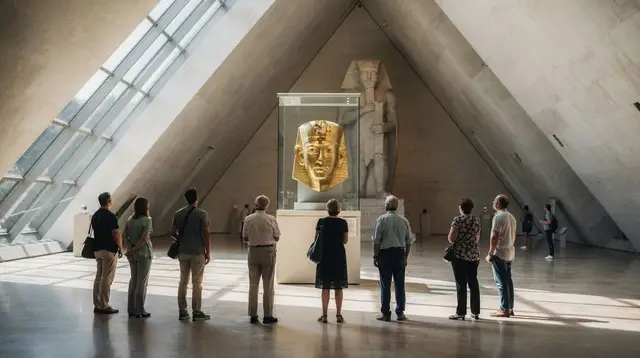
The Grand Egyptian Museum sits immediately next to the plateau and is a natural pairing for the same day, but it is a separate ticket, a separate building, and easily another half-day on its own — see our Grand Egyptian Museum guide for how to plan that combination without rushing either one. Evening visitors sometimes stay on for the sound and light show at the pyramids after dark; details are in our Giza sound and light show guide. Neither belongs in the same window as the self-guided daytime walk described here — treat them as separate stops on the same trip, not add-ons to the same visit.
For a broader sense of how Giza fits into a wider Cairo plan, our things to do in Giza page and our one day in Cairo itinerary both show where this visit sits relative to everything else. If you are buying tickets ahead of arrival, our guide to sightseeing tickets explained covers what to expect at the booths.
Self-guided Giza visit at a glance
| Stop | Position on the plateau | Notes |
|---|---|---|
| Pyramid of Khufu | Nearest the main gate for most arrivals | Largest of the three; separate ticket to enter a chamber |
| Pyramid of Khafre | Southwest of Khufu | Appears taller from some angles; retains some casing stone near the top |
| Pyramid of Menkaure | Southwest of Khafre | Smallest of the three; usually the quietest stop |
| Great Sphinx | Lower ground, near the Valley Temple | Convenient last stop, close to the main exit |
Giza plateau: frequently asked questions
Do I need a guide to visit the Giza pyramids?
No. The site is open to independent visitors and the route between the three pyramids and the Sphinx is simple to follow without one. A guide adds historical context but is not required to get in or move around the plateau.
What is the best order to see the Giza plateau on foot?
Most independent visitors start near the Great Pyramid of Khufu, walk on to Khafre and Menkaure, then come back down to the Great Sphinx last, since the Sphinx enclosure sits at a lower point of the plateau closer to the main exit.
How long does it take to walk the Giza plateau?
Plan two to three hours to see all three pyramids and the Sphinx at a walking pace, not counting the trip to and from your hotel. Add more time if you stop for photo viewpoints or go inside a pyramid chamber.
Is it hot walking around Giza?
The plateau has almost no shade, and the sand and stone reflect heat. Even in the cooler months the midday sun is strong; in summer, walking is genuinely uncomfortable after mid-morning. Opening time is the most comfortable window.
Should I take a camel or horse ride at Giza?
It is optional, not necessary to see the site, and prices are negotiated on the spot rather than fixed. If you want the experience, agree the price and duration before mounting, and treat any unsolicited approach with caution.
Are there official guides at the Giza plateau?
Licensed guides exist, but so do unofficial ones who approach visitors directly at the gate or along the paths. A legitimate guide will show identification without being asked twice; anyone pressuring you to decide immediately is a signal to walk on.
Can you walk between the pyramids and the Sphinx, or do you need transport?
You can walk between all four main points on the plateau. Some visitors use the shuttle or a hired horse and cart to cover the distance faster in the heat, but nothing on the plateau itself requires a vehicle.
Giza pyramids and Sphinx tours on GetYourGuide
Verified deep-linked GetYourGuide tours. Book through these links and we earn a small commission at no cost to you.
GetYourGuide does not provide a product photo for this activity — the image shows the meeting point, photographed by us.