Photography rules at Egyptian sites
Can you take photos inside Egyptian museums and monuments?
It depends on the site and can change without notice, so treat any rule you read online as a starting point, not a guarantee. Most outdoor areas at Giza and Saqqara allow phone and camera photography freely; indoor galleries, tombs and some museum halls restrict flash, tripods or cameras entirely, and staff at the entrance or ticket window give the version that applies that day.
What to expect with a camera in Cairo and Giza
Photography at Egypt’s major sites is not governed by one national rulebook that a guide can copy out for you. It is set site by site, sometimes room by room, and it is enforced by whoever is on duty that day. That is not a dodge — it is the honest state of things, and it matters more here than a list of dos and don’ts would. This page will not invent permit fees, tripod bans or per-site schedules that nobody has published. Instead it sets out what is broadly consistent across Giza, Saqqara and central Cairo’s museums, what genuinely varies, and how to find the current answer before you’re standing at a ticket window with a raised camera and a staff member shaking their head.
Two things worth separating from the start: this page covers the mechanics of taking a photo — cameras, phones, flash, tripods, drones, low light. It does not cover how to dress or behave inside a mosque or church, which is a different subject with its own etiquette; for that, see mosque etiquette in Cairo. The two overlap at sites like the Citadel of Saladin and Mosque of Muhammad Ali or Al-Azhar, where a camera rule and a dress code apply at the same time but are not the same rule.
The general pattern, and why it’s only a pattern
Across most outdoor archaeological areas — the open plateau at Giza, the grounds at Saqqara, the courtyards of Islamic Cairo — handheld photography with a phone or a standard camera is normally not a problem. Indoors is where things tighten: museum galleries, tomb interiors, and any space with painted or fragile surfaces tend to carry restrictions on flash at minimum, and sometimes on photography altogether. Tripods, monopods, selfie sticks and anything that reads as “professional” equipment sit in a grey zone that can go either way depending on the site, the day and who’s checking bags at the entrance.
That’s the pattern. It is not a guarantee, and this guide is not going to dress it up as one. The only reliable source for what applies to you, today, at the site you’re visiting, is the signage at the entrance and the staff working the ticket desk or gallery door. If a blog, a forum post or an old guidebook gives you a specific number — a photo permit fee, a tripod surcharge, a flat fine — treat it as out of date until someone at the site confirms it. Prices and enforcement in Egypt change without much notice, and a figure that was accurate a year ago may not be now.
Giza: pyramids, Sphinx, and the plateau
The Giza Plateau is largely open air, and that’s where photography is most straightforward: the pyramids of Khufu, Khafre and Menkaure, and the Great Sphinx, are photographed constantly by visitors with phones and cameras with no special arrangement needed for personal use. Where it gets less predictable is inside the pyramids themselves, if you pay the separate entry to climb into the burial chambers — cramped, low-ceilinged spaces where camera policy has varied by visit, and where a tripod would be impractical regardless of the rule. Camel and horse operators around the plateau will often offer to take your photo as part of a sales pitch; that’s a commercial transaction, not a site rule, and worth treating as such. If you’re at Giza for the evening sound and light show, low light makes a tripod tempting — ask the venue staff before you set one up rather than assuming.
The Grand Egyptian Museum and the Egyptian Museum in Tahrir
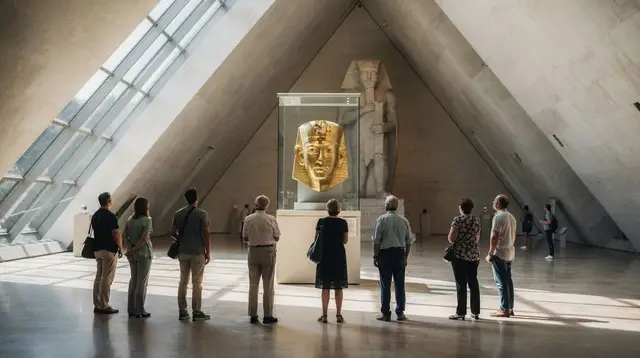
Cairo now has two major Egyptology museums running at the same time, and each has its own approach to cameras. The Grand Egyptian Museum (GEM), next to the Giza plateau, opened officially on 1 November 2025 and holds the complete Tutankhamun collection for the first time under one roof. As a newly opened institution with a huge volume of visitors, its photography terms have already been reported differently by different visitors in its first months — some galleries open to phone photography, others restricted, flash generally discouraged around objects. Given how recently it opened, treat anything you read about its camera policy, including this page, as a starting point to confirm on site rather than a fixed rule.
The Egyptian Museum on Tahrir Square, open since 1902, did not close when the GEM opened — the two run in parallel, each with its own collection and its own visitor rules, and mixing them up is one of the more common mistakes travellers make when planning. Tahrir has historically applied its own camera terms, separate from whatever the GEM does, and separate again from the Coptic Museum or the museum at the National Museum of Egyptian Civilization (NMEC) in Fustat, where the royal mummies have been displayed since the Pharaohs’ Golden Parade of April 2021. If your itinerary includes more than one of these, expect to ask the same question — “can I photograph in here?” — three separate times and get three separate answers. For a side-by-side comparison of the two Egyptian Museums, see Grand Egyptian Museum vs Egyptian Museum (Tahrir).
The mummy hall at the NMEC specifically has tended to run stricter conditions than the rest of that museum, in keeping with how sensitive that display is. Again, no fixed rule is published in a way reliable enough to state here as fact — check at the counter when you buy your ticket.
Saqqara, Dahshur and tomb interiors
Out at Saqqara, where the Step Pyramid of Djoser stands, and at Dahshur with the Bent and Red Pyramids, the open desert setting again makes casual photography easy. The exception is tomb interiors — several of the mastabas and burial chambers around Saqqara have painted walls that staff are protective of, and flash photography in particular is the kind of thing that gets stopped on sight. If a guide or a private driver takes you into one of these spaces as part of a tour, ask them directly before you start shooting; they will usually know that specific tomb’s current rule better than any general guide can.
Islamic and Coptic Cairo
In the mosques, churches and synagogues of Islamic Cairo and Coptic Cairo — the Hanging Church and Ben Ezra Synagogue among them — photography is generally tolerated in the same courtyards and prayer halls that visitors are allowed to walk through, but it sits alongside the separate matter of dress and conduct covered in the mosque etiquette guide linked above. A few specific interiors restrict photography during active prayer times or in areas set apart for worship rather than viewing; again, this is read from signage and staff cues on the day, not from a published list. In the market alleys of Khan el-Khalili, photographing stallholders and their goods without asking is the kind of thing that causes friction even where it’s technically allowed — a quick nod or word before you point a lens at someone’s stall goes a long way.
Tripods, drones and equipment that draws attention
Handheld phones and compact cameras cause the least friction anywhere on this list. Beyond that, three categories are worth flagging honestly rather than glossing over:
- Tripods and monopods — tolerated in some open areas at quiet times, refused in enclosed galleries and tomb interiors more often than not. There is no fixed fee structure that can be quoted here with confidence; ask before setting one up.
- Professional or commercial equipment — larger rigs, lighting kits or anything that signals filming rather than personal photos can trigger a different conversation with staff, sometimes involving permissions arranged in advance rather than at the gate. If you’re shooting for work, sort this out through an official channel before travelling, not on arrival.
- Drones — flying a drone around archaeological sites or over Cairo generally falls into restricted or prohibited territory as a matter of aviation and security rules well beyond museum policy. Do not plan around being able to fly one; if it matters to your trip, that’s a question for an official channel well ahead of time, not something to test at the site.
Light, heat and the practical side of shooting outdoors
Beyond permissions, the desert light itself is worth planning around. Midday sun at Giza and Saqqara is harsh and flat for photography, and from June to August the heat alone — often above 35°C — makes standing around adjusting a shot uncomfortable fast; arriving at opening time solves both problems at once, giving softer light and cooler air before the site fills up. Sandstorm season, the khamsin winds that can appear between March and May, brings a haze that dulls colour and coats equipment in fine dust — worth a lens cloth and a bag that closes properly if you’re travelling then. None of this is a rule anyone enforces; it’s just what the desert does to a camera, on top of whatever the site’s own policy happens to be that day.
Booking a guided visit if photography matters to you
If getting good, unhurried photographs inside the Egyptian Museum is part of why you’re going, a private guide can be worth it — not because they can override a site’s rules, but because they know the current answer for that specific museum and can time your visit around quieter galleries. A private guided tour of the Egyptian Museum style visit, booked as a private guided tour of the Egyptian Museum, moves at your pace rather than a group’s, which matters if you want to stop and compose a shot rather than keep up.
A shorter option, a half-day tour combining central Cairo with the Egyptian Museum, works if photography is one stop among several rather than the whole point of the day. Travellers who’d rather ask these questions of a guide of the same gender can look at a female-guided private tour of the Egyptian Museum. And if you’d like the museum visit paired with something more social later in the day, a downtown Cairo half-day tour that ends with an Egyptian dinner bookends the sightseeing with a meal rather than leaving you to find one alone.
Check the current terms and price on the booking page before confirming, since availability and specifics change; this guide focuses on what to expect on the ground with a camera, not on locking in a tariff that may no longer be accurate.
Before you go: how to actually find the current rule
Given how much varies, the practical approach is simple and repeats at every site on this list:
- Read the signage at the entrance or ticket window — this is usually the most current source, more current than most articles written before a site’s latest policy update.
- Ask the staff checking tickets or bags directly: “Can I take photos here? Flash? Tripod?” A short, direct question gets a clearer answer than assuming.
- If you’re on a self-guided visit, build in a moment at each entrance to ask, rather than finding out mid-gallery when a staff member stops you.
- If a guide is with you, they will usually know the current rule for that specific site better than any general write-up — use them as your source on the day rather than something you read in advance.
- Don’t carry equipment you haven’t cleared in advance — a tripod refused at the door is a minor inconvenience; a drone confiscated is a bigger one.
None of this replaces checking on site. What varies from museum to museum, and sometimes gallery to gallery, is set locally and can change with no notice to anyone outside Egypt. Treat every figure or rule you read — including on this page — as a starting point, and the person at the desk in front of you as the actual answer.
Cairo trip planning and itinerary tours on GetYourGuide
Verified deep-linked GetYourGuide tours. Book through these links and we earn a small commission at no cost to you.
GetYourGuide does not provide a product photo for this activity — the image shows the meeting point, photographed by us.