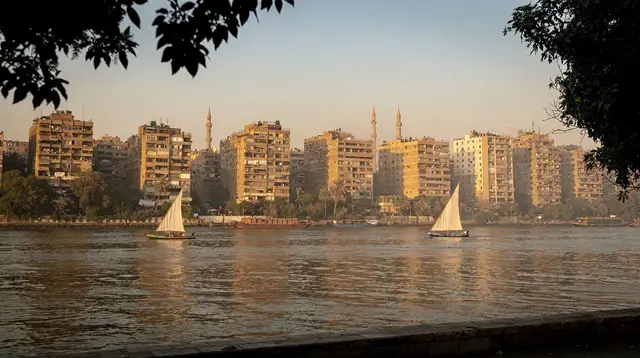
A walled quarter of its own, not an annex of Khan el-Khalili
Coptic Cairo sits inside the old Roman fortress of Babylon, on the east bank of the Nile south of Downtown. It predates the mosques and bazaars of Islamic Cairo by centuries, and it works as a separate outing rather than an add-on to a Citadel or Khan el-Khalili day. If you have already read the Islamic Cairo guide or booked the Khan el-Khalili bazaar guide, treat this quarter as its own half-day rather than a stop bolted onto that itinerary. The two districts are a short car or metro ride apart, both within reach of hotels in central Cairo, but they are architecturally and historically distinct: one is Cairo’s Islamic-era core, this one is its Christian and Jewish foundation.
Inside the fortress walls, the quarter is compact and mostly pedestrian. Once you are through the entrance, everything worth seeing is within a few minutes’ walk: the Hanging Church, the Ben Ezra Synagogue, the Coptic Museum, and several other churches tucked into narrow lanes. This is one of the few parts of central Cairo where a visit does not depend on a long taxi ride between sights, which makes it a good choice for travellers who find the rest of the city’s traffic tiring.
Getting your bearings inside the compound
The fortress of Babylon gives the district its shape: thick Roman-era walls, a sunken entrance road, and a cluster of churches, a synagogue and a museum arranged along narrow stone lanes. There is no single “main street” to follow, and signage is limited, so most visitors either hire a guide for an hour or two or simply wander with a map, since the whole compound is small enough that getting briefly lost costs only a few minutes.
A sensible order for a first visit is the Coptic Museum first, since it gives context for what follows, then the Hanging Church, then Ben Ezra Synagogue, finishing with a walk past the smaller churches (Saint Sergius and Saint Barbara among them) if time and interest allow. None of this needs to be rushed: the whole loop is walkable in under an hour, though most visitors linger closer to two or three. Travellers who want the history explained rather than pieced together from plaques can read the case for hiring an Egyptologist guide in Cairo, which applies just as well to this compound as to Giza or Saqqara.
The Hanging Church
The Hanging Church (Al-Muallaqa) takes its name from its position, built over the gatehouse towers of the old Roman fortress, with its nave suspended above the passage below. It is one of the oldest churches in Egypt and has been rebuilt and restored many times over the centuries, which shows in the mix of styles inside: marble pulpits, cedar screens inlaid with ivory, and icons spanning different periods.
The church is still in active use for services, so visiting hours can shift around religious observances, and it is best to treat any opening time you read elsewhere as approximate rather than fixed. Photography is generally tolerated in the nave but not always in every side chapel; watch for posted signs or ask, rather than assuming. The same caution applies across the compound and at most Egyptian heritage sites, which is why it is worth a quick read of the photography rules at Egyptian sites before you arrive.
Ben Ezra Synagogue
A short walk from the Hanging Church, Ben Ezra Synagogue is the oldest synagogue in Cairo and, by tradition, sits on or near the spot associated with the biblical account of the infant Moses. Its most famous historical association is the Cairo Geniza, a vast trove of medieval Jewish manuscripts and documents discovered here in the nineteenth century, most of which are now held in research libraries abroad rather than on site.
The building itself is modest compared with the Hanging Church, with a simple basilica layout and understated decoration, but it is one of the few active reminders of Cairo’s historic Jewish community, which has largely dispersed. As with the churches nearby, dress and behave as you would in any active place of worship, and expect a security check at the entrance. Readers who want the fuller story behind both buildings can turn to the dedicated Hanging Church and Ben Ezra Synagogue guide, which goes deeper into their histories than this overview does.
The Coptic Museum
The Coptic Museum is the best place in Cairo, and arguably in Egypt, to see the material culture of Egypt’s Christian era in one place: stone and wood carvings, textiles, icons, manuscripts and everyday objects from the Coptic period, spanning roughly the third to the twelfth centuries. It is a manageable size, not a Grand Egyptian Museum-scale undertaking, and a focused visit takes about an hour, longer if you read the labels closely.
For travellers trying to make sense of Coptic Cairo’s churches, the museum is worth visiting early in the day: it supplies the historical framing that makes the Hanging Church’s screens and icons, or Ben Ezra’s layout, easier to place in context. Several guided options bundle the museum with the churches into a single morning, which suits visitors who would rather have someone explain what they are looking at than piece it together alone. The Coptic Museum guide covers what is on display gallery by gallery for anyone who wants to plan the visit in more detail.
Where the royal mummies actually are
One confusion is worth clearing up before you plan the day: the royal mummies of Egypt’s pharaohs are not at the Egyptian Museum on Tahrir Square. They were moved in April 2021, in the widely covered Pharaohs’ Golden Parade, to the National Museum of Egyptian Civilization (NMEC) in Fustat, a district immediately south of Coptic Cairo. This is a common point of confusion because the Tahrir museum held the mummies for decades and many older guidebooks and blog posts still describe it that way.
The Egyptian Museum on Tahrir Square, opened in 1902, has not closed and still holds a substantial collection, including Tutankhamun-era pieces not transferred to the new Grand Egyptian Museum; it is simply no longer where the royal mummies are shown. Anyone still deciding whether Tahrir is worth a separate stop can read the Egyptian Museum Tahrir guide for what remains there. If seeing the mummies is a priority, plan for the NMEC specifically, not Tahrir; the royal mummies at the NMEC guide lays out what the newer museum holds. Because Fustat sits right next to Coptic Cairo, the two are easy to combine into one outing without adding a separate cross-town trip: see the churches and museum in the morning, then walk or take a short taxi ride to the NMEC in the afternoon.
Dress and behaviour in Coptic Cairo’s churches
Coptic Cairo’s churches and the Ben Ezra Synagogue are active places of worship, not open-air monuments, and the same courtesy rules that apply in Islamic Cairo’s mosques apply here. Cover shoulders and knees; women may be asked to cover their hair in some churches, though this is applied less strictly than in mosques. You are not generally required to remove your shoes in the churches, unlike in mosques, but follow any signage or staff instruction on the day.
Keep voices low during services, and be ready for a security screening at the entrance to the compound and again at the synagogue, which is standard practice rather than a sign of anything unusual. If you are visiting with a guide, they will typically manage entry logistics and any small entrance contributions expected at individual sites. The dress expectations here are close to those covered in the mosque etiquette in Cairo guide, even though these are churches and a synagogue rather than mosques.
Getting there and getting around
Coptic Cairo sits close to the Mar Girgis metro stop on the Cairo Metro’s Line 1, which makes it one of the more transit-friendly destinations in the city and a reasonable option if you would rather skip a car in traffic; the Cairo Metro guide covers how the line system works for visitors who have not used it before. From hotels in Downtown, Zamalek or Garden City, a taxi or ride-hailing trip through Uber or Careem typically runs well under an hour, though Cairo’s traffic makes any specific estimate unreliable at peak times; building in extra time is safer than assuming a quick hop. The Uber and Careem in Cairo guide has more on how those apps work locally.
Once inside the fortress walls, everything is on foot. There is no need for a driver or taxi to move between the Hanging Church, Ben Ezra Synagogue and the Coptic Museum; the whole cluster sits within a few hundred metres. If you are continuing on to the NMEC afterward, that is a short separate ride or a longer walk, since it sits just outside the old fortress perimeter in Fustat.
Pairing Coptic Cairo with the NMEC
Because Fustat and Coptic Cairo are so close together, many visitors treat them as one extended half-day rather than two separate trips. A common pattern is: Coptic Museum, then the Hanging Church and Ben Ezra Synagogue, then a short ride to the NMEC to see the royal mummies and the broader civilisation exhibits, finishing by early afternoon. This avoids doubling back across the city on a later day just for the mummies.
If you are short on time and have to choose, the churches and museum give a more concentrated sense of Coptic Cairo’s own history, while the NMEC is the one place in the city to see the royal mummies. Travellers assembling a longer one-day itinerary through Islamic and Coptic Cairo should budget for both halves separately rather than rushing either.
Tours worth booking
Coptic Cairo is straightforward to visit independently, especially by metro, but a guide adds real value here: much of what makes the churches and museum interesting is historical context that is not always explained on site. A private half-day covering Coptic Cairo and the nearby Cave Church (Saint Simon) at the Mokattam quarry works well for travellers who want the quarter explained rather than just walked through.
a private day tour covering Coptic Cairo and the Cave Church pairs the Hanging Church and Ben Ezra Synagogue with the rock-cut Cave Church complex, a site most independent visitors miss entirely.
For travellers also planning an Islamic Cairo day, a combined religious sites tour of Islamic and Coptic Cairo covers both quarters with one guide, useful if your schedule only allows a single day for Cairo’s religious heritage.
If you would rather finish the day on the water, a Coptic Cairo and Cave Church tour that ends with a Nile felucca ride closes the afternoon with a sail rather than a taxi back to the hotel.
Coptic Cairo travel questions
Are the royal mummies at the Egyptian Museum on Tahrir Square?
No. The royal mummies were moved to the National Museum of Egyptian Civilization in Fustat in April 2021, during the Pharaohs’ Golden Parade. The Egyptian Museum on Tahrir Square remains open with a large collection, but it no longer displays the mummies.
Is Coptic Cairo the same area as Islamic Cairo?
No, they are separate districts. Coptic Cairo is built around the old Roman fortress of Babylon and centres on the Hanging Church, Ben Ezra Synagogue and the Coptic Museum. Islamic Cairo covers a different part of the city, including the Citadel and Khan el-Khalili bazaar.
How do I get to Coptic Cairo from central Cairo hotels?
The area is close to the Mar Girgis stop on Cairo Metro Line 1, a reasonable option given the city’s traffic. A taxi or Uber or Careem ride from Downtown, Zamalek or Garden City usually takes under an hour, though Cairo’s traffic can extend that at busy times.
How much time should I set aside for Coptic Cairo?
Half a day covers the Hanging Church, Ben Ezra Synagogue and the Coptic Museum at an unhurried pace. Add extra time if you plan to continue to the National Museum of Egyptian Civilization in Fustat the same afternoon.
What should I wear inside the churches and synagogue?
Cover shoulders and knees, as you would for a mosque visit elsewhere in Cairo. Women may be asked to cover their hair in some churches. Shoe removal is generally not required, unlike in mosques, but follow posted guidance on the day.
Can I combine Coptic Cairo with the National Museum of Egyptian Civilization in the same day?
Yes, and many visitors do. The NMEC sits in Fustat, a short ride or a longer walk from the Coptic Cairo compound, which makes it easy to see the churches and museum in the morning and the mummies in the afternoon.
Is Coptic Cairo walkable, or do I need a driver inside the district?
Once inside the fortress walls, the district is entirely walkable: the Hanging Church, Ben Ezra Synagogue and Coptic Museum are all within a few hundred metres of each other. You only need transport to get to and from the compound.
Does the Coptic Museum need much time, or is it a quick stop?
A focused visit takes about an hour, a little longer if you read the exhibit labels closely. It is a manageable size compared with Cairo’s larger museums, and it is worth visiting before the churches for context.