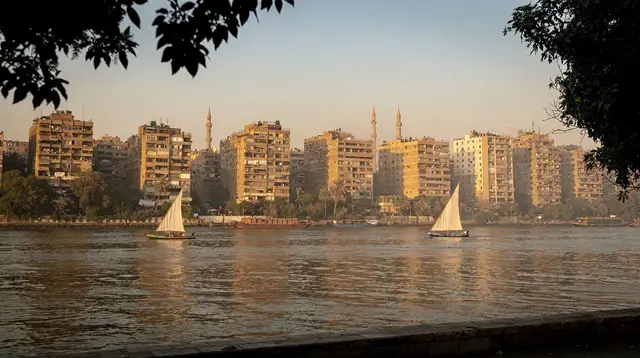
Downtown, Zamalek, Garden City, Heliopolis: where you actually sleep
Most Cairo trips get this backwards. People plan the pyramids, then Luxor, then wonder where to sleep almost as an afterthought. In practice, Cairo itself is the base for most of a trip, not a stopover before the “real” sights. You pick a hotel in one of four areas, and everything else gets organized around getting back to it each evening.
Downtown Cairo is the historic 19th-century core, walkable in patches, dense with traffic everywhere else, and close to Tahrir Square and the Egyptian Museum. It suits travellers who want to be in the middle of things and don’t mind noise and crowds outside the hotel door.
Zamalek sits on an island in the Nile, quieter, greener, with a concentration of restaurants and cafes, and a short drive from Downtown across one of the Nile bridges. It’s a common pick for a calmer base that’s still central.
Garden City, just south of Downtown along the river, is smaller and more residential, with a handful of well-known hotels facing the Nile. It works for the same reasons as Zamalek: closer to the water, a step removed from the densest traffic.
Heliopolis, northeast of the centre and near Cairo International Airport (CAI), suits travellers on a short layover, an early flight, or anyone prioritising airport access over proximity to Islamic Cairo and Downtown. From Heliopolis, expect a longer drive into the historic core than from Zamalek or Garden City.
None of these four are close to the Giza Plateau or the Grand Egyptian Museum, which sit across the Nile on the western edge of the city and are covered on their own page rather than here. If your plan is pyramids-first, that changes where you’d want to sleep; this page assumes you’re building your stay around Cairo’s own historic districts.
| Base | Feel | Distance to Islamic Cairo | Distance to airport (CAI) |
|---|---|---|---|
| Downtown | Central, busy, walkable in patches | 15-25 min by car | 40-60 min |
| Zamalek | Quieter, riverside, cafe-heavy | 20-30 min by car | 45-70 min |
| Garden City | Small, residential, Nile-facing | 20-30 min by car | 45-70 min |
| Heliopolis | Near the airport, less central | 30-45 min by car | 15-25 min |
A megacity read one district at a time
The single biggest misconception first-time visitors bring to Cairo is scale. It isn’t a compact old-town you cover on foot in an afternoon. It’s one of the largest metro areas in the world, and its landmarks are spread across districts that don’t connect on foot, separated by roads that stay busy from mid-morning until well past dark. The realistic way to see it is one district at a time, by car, usually with a private driver for the day, rather than a self-guided walking loop that tries to link everything.
That changes how you plan. Instead of a single day trying to see the Citadel, Khan el-Khalili, the Hanging Church and the Egyptian Museum, split them: a day for Islamic Cairo, a separate day (or half-day) for Coptic Cairo, and treat Downtown’s own sights, like the Egyptian Museum on Tahrir Square, as their own half-day. Trying to compress all of it into one outing usually means arriving tired, rushed, and hitting most sites near closing time.
The realistic travel times across Cairo guide has more detail, but the short version: budget more time between districts than a map distance suggests, and don’t schedule a hard reservation, like a restaurant or a show, right after a cross-city transfer.
Islamic Cairo: mosques, the Citadel, and the bazaar
Islamic Cairo is the district built up under successive Islamic dynasties, and it’s inscribed as part of Historic Cairo on the UNESCO World Heritage list since 1979. It’s where most visitors spend a full day, and it rewards one.
The Citadel of Saladin sits on high ground with views back across the city, and inside it is the Mosque of Muhammad Ali, the large 19th-century mosque with the twin minarets that dominate Cairo’s skyline in photographs. It’s usually the first stop of the day, both because of the views and because it opens early.
Al-Azhar Mosque, founded in 970, is one of the oldest working mosques and universities in the Islamic world, and it sits close to Khan el-Khalili, Cairo’s best-known bazaar, a dense knot of alleys selling spices, metalwork, textiles and souvenirs. Prices aren’t fixed here the way they are in a mall, so bargaining is normal; the guide to haggling in Cairo covers what a realistic opening offer looks like.
Al-Muizz Street runs through the heart of the district, lined with restored Mamluk and Ottoman buildings, and is worth a slow walk rather than a quick pass-through. Sultan Hassan Mosque, one of the largest and most architecturally significant mosques in Cairo, sits a short drive from the Citadel and pairs well with it on the same morning.
A realistic single day looks like: Citadel and Mosque of Muhammad Ali in the morning, lunch nearby, then Al-Muizz Street on foot, finishing at Khan el-Khalili in the late afternoon when the light and the crowds both ease off. Trying to also fit Coptic Cairo into the same day means seeing all of it too fast.
Coptic Cairo: churches, the synagogue, and where the mummies went
Coptic Cairo is a separate, older enclave, a walled area with some of Cairo’s oldest churches and the roots of the city’s Christian community going back to the early centuries. It’s also part of the Historic Cairo UNESCO listing.
The Hanging Church, built above the gatehouse of a Roman fortress, is the best-known stop, along with the Ben Ezra Synagogue, a former church converted into a synagogue and linked to one of the oldest Jewish communities in Egypt. The Coptic Museum, inside the same enclave, holds a substantial collection of Coptic art and manuscripts and is worth an hour on its own.
This is also the place to clear up a common point of confusion: the royal mummies, including well-known pharaohs, are no longer displayed at the Egyptian Museum on Tahrir Square. They moved to the National Museum of Egyptian Civilization (NMEC), in the nearby district of Fustat, during the Pharaohs’ Golden Parade in April 2021, and that’s where they’re shown today. Fustat sits close enough to Coptic Cairo that the two are often combined into the same outing, but they’re distinct sites with separate tickets. If a royal mummy is the reason you’re visiting, confirm you’re heading to the NMEC, not Tahrir Square; the short history of that move and the NMEC guide both cover what’s on display where.
The Egyptian Museum on Tahrir Square hasn’t closed, and it still holds a large collection, including Tutankhamun’s smaller pieces that didn’t move to the Grand Egyptian Museum near Giza. The two museums, Tahrir and the newer Grand Egyptian Museum, coexist; the comparison guide is useful if you’re deciding which one, or both, to visit.
For the museum visit itself, a guide who can walk you through the collection in order, rather than a self-paced wander through crowded halls, tends to be worth it on a first visit. A private guided tour of the Egyptian Museum on Tahrir Square covers the highlights at a reasonable pace, or if your schedule points elsewhere, a guided tour of whichever Cairo museum fits your day lets you pick between Tahrir and the NMEC.
Downtown itself, and a break from temples
Downtown Cairo’s own sights are easy to underrate next to Islamic and Coptic Cairo. Tahrir Square and the streets around it carry 19th and early 20th-century architecture, a mix of European-influenced facades from Cairo’s period as a planned modern capital. It’s worth a slow walk on the same day as the Egyptian Museum, rather than a separate trip.
Zamalek, across the river, is where a lot of visitors end up for dinner regardless of where they’re staying, and it’s also the easiest place to arrange a Nile outing. A slow sunset felucca sail or a dinner cruise with a show is a reasonable way to close a day that’s otherwise been spent in mosques, churches and museum halls. If a full day of walking history isn’t the plan for every day of the trip, a Nile kayaking and high-ropes outing is a more active alternative for a lighter afternoon.
Getting between districts, and why traffic is a planning input
Cairo’s traffic is dense for most of the day, not just at rush hour, and that has direct consequences for how you sequence a day. A transfer that looks short on a map, Downtown to Islamic Cairo, for instance, can still take 20-30 minutes in a car, and longer during school hours or before evening prayers on a Friday.
A private driver, or a ride through Uber or Careem, is the normal way to move between districts; Cairo’s metro, while useful for a few specific routes, doesn’t cover Islamic or Coptic Cairo well and isn’t the practical choice for a day built around those sights. The guide to hiring a private driver and the guide to Uber and Careem in Cairo both cover the trade-offs.
Friday is the weekly day of rest, and mosque visiting hours shift around midday prayers; plan Islamic Cairo sightseeing for the morning or after early afternoon on a Friday. During Ramadan, opening hours across the city change and some sights close earlier; check current hours before building a Ramadan-season itinerary.
| Route | Typical travel time by car |
|---|---|
| Downtown to Islamic Cairo (Citadel) | 15-25 min |
| Islamic Cairo to Coptic Cairo | 20-30 min |
| Zamalek to Downtown | 15-20 min |
| Heliopolis to Downtown | 30-45 min |
| Cairo (any base) to Giza Plateau | 45-90 min |
Cairo, Giza, and everywhere else: how this page fits
This page covers Cairo the city: where you sleep, and the districts you visit on foot and by car within it, Islamic Cairo and Coptic Cairo above all, plus Downtown and Zamalek along the Nile. The Giza Plateau, the pyramids of Khufu, Khafre and Menkaure, the Great Sphinx, and the Grand Egyptian Museum sit on their own Giza destination page, since that district has its own hotels, its own travel times from central Cairo, and enough content to need the space.
Saqqara and Dahshur, with the Step Pyramid of Djoser and the Bent and Red Pyramids, are a half-day or full-day trip from a Cairo base rather than something inside the city itself; a private Saqqara, Dahshur and Memphis tour with lunch included is the standard way to see all three sites in one outing. Alexandria, about three hours away by road, is a longer day trip still sold from a Cairo hotel; a full day trip to Alexandria from Cairo covers the Bibliotheca Alexandrina and the coastal sights without requiring an overnight stay. Neither belongs on this page, but both are commonly booked from the same Cairo hotel this page is about.
If you’re deciding how many days to give the city before moving on to Giza, Saqqara or further afield, the two-day Cairo itinerary and three-day Cairo itinerary both build around this same Downtown, Islamic Cairo, Coptic Cairo split, and the single-day version is there for a tight layover, though it’s a rushed day rather than a comfortable one.
Etiquette in mosques and churches
Both districts covered here involve active places of worship, not open-air museums, and dress and behaviour expectations follow from that. Shoulders and knees covered for everyone, women covering their hair inside mosques, and shoes off before entering prayer areas. Churches are less strict on head covering but the same modest-dress expectation applies. The mosque etiquette guide has the specifics, including what’s provided on-site versus what to bring yourself.
Photography is generally fine in courtyards and public areas of both mosques and churches, though some interior sections restrict it, particularly during active prayer times; check signage or ask before photographing worshippers directly.
Cairo neighbourhoods and day visits: questions people ask
Where should I stay in Cairo: Downtown, Zamalek, or Heliopolis?
Downtown puts you closest to Islamic Cairo and the Egyptian Museum but is the busiest and noisiest option. Zamalek and Garden City are quieter riverside alternatives a short drive from the centre. Heliopolis suits a short layover or an early flight, since it’s closest to Cairo International Airport (CAI), but it’s the furthest from Islamic and Coptic Cairo.
Are the royal mummies still at the Egyptian Museum on Tahrir Square?
No. The royal mummies moved to the National Museum of Egyptian Civilization (NMEC) in Fustat during the Pharaohs’ Golden Parade in April 2021. The Egyptian Museum on Tahrir Square remains open with a large collection, but the royal mummy exhibit is now specifically at the NMEC.
Can I walk between Islamic Cairo and Coptic Cairo?
Not comfortably. They’re separate districts several kilometres apart through dense city traffic, not adjoining neighbourhoods. Most visitors treat them as two separate outings, each covered largely on foot once you arrive, connected by a car or driver rather than a walk.
How long does it take to get around central Cairo by car?
Expect 15-30 minutes for most cross-district transfers, Downtown to the Citadel or Islamic Cairo to Coptic Cairo, for example, and longer during school hours, before evening prayers, or on a Friday. Traffic stays heavy through most of the day, so it’s worth building in buffer time rather than scheduling back-to-back stops with no margin.
What should I wear when visiting mosques and churches in Cairo?
Cover shoulders and knees, and expect to remove your shoes before entering prayer areas inside mosques. Women cover their hair inside mosques; a scarf is usually enough and some sites lend one at the entrance. Churches are less strict about head covering but the same modest-dress standard applies throughout Coptic Cairo.
Is Khan el-Khalili worth visiting, and when?
Yes, for the atmosphere and the range of goods, though prices aren’t fixed and bargaining is expected. Late afternoon tends to be more comfortable than midday heat, and it pairs naturally with an Islamic Cairo day that starts at the Citadel and ends at the bazaar.
Do I need a guide for Islamic and Coptic Cairo?
Not strictly, but the history behind individual buildings, particularly in Islamic Cairo’s mosques and Coptic Cairo’s churches, isn’t always explained on-site. A guide adds context that’s easy to miss otherwise, and for museum visits specifically, a guided museum tour covers the Egyptian Museum or the NMEC at a paced walkthrough rather than a self-guided wander through crowded halls.