Royal mummies at the NMEC: the new address in Fustat
Where are the royal mummies now?
The royal mummies moved from the Egyptian Museum in Tahrir to the National Museum of Egyptian Civilization (NMEC) in Fustat during the Pharaohs' Golden Parade in April 2021. They remain there, in a dedicated hall, and are not part of the Grand Egyptian Museum collection.
Why “the mummy room at Tahrir” is out of date
For decades, the royal mummies of Egypt’s pharaohs sat in a dim room on the upper floor of a museum in central Cairo. That’s where most guidebooks, blog posts, and even some tour listings still put them. It’s wrong, and it has been wrong since April 2021, when the mummies moved to the National Museum of Egyptian Civilization (NMEC) in Fustat — not to the Egyptian Museum’s galleries and not to the Grand Egyptian Museum (GEM).
That month, Egypt moved 22 royal mummies — kings and queens including Ramesses II and Hatshepsut — from Tahrir to the National Museum of Egyptian Civilization (NMEC) in Fustat, a few kilometers away in Old Cairo. The transfer was staged as a televised event, the Pharaohs’ Golden Parade, with the mummies carried in custom vehicles through Cairo’s streets. It was covered widely at the time, but travel content has a long tail, and a lot of it was never corrected. If you’re booking a museum day around what you read a few years ago, you’re planning around a museum that no longer holds this collection.
This guide is only about that: where the royal mummies are now, what the NMEC actually is, and how to build a realistic visit around it. It doesn’t cover the Grand Egyptian Museum’s Tutankhamun collection or the rest of what’s on display at Tahrir — those are worth separate research, and this page would only dilute them.
What the NMEC actually is
The National Museum of Egyptian Civilization is not a rebrand of the Egyptian Museum, and it’s not an annex of the Grand Egyptian Museum either. It’s a distinct institution with its own remit: telling the story of Egyptian civilization across a long span, from prehistory through the pharaonic, Greco-Roman, Coptic, and Islamic periods, up to the present. The royal mummies hall is one part of that story, and for most visitors, the part they came for.
Inside the mummies hall, the royal remains are presented in low-light, climate-controlled cases, arranged with attention to preservation rather than spectacle. It reads as a more sober, more clinical space than the crowded upper floor of old Tahrir — fewer people, more room to actually look.
It’s worth repeating the boundary lines clearly, because the three big Cairo museums get confused constantly:
- Egyptian Museum (Tahrir) — open since 1902, still holds a large general collection, no longer holds the royal mummies.
- Grand Egyptian Museum (GEM) — next to the Giza plateau, officially inaugurated 1 November 2025, holds the complete Tutankhamun collection.
- National Museum of Egyptian Civilization (NMEC) — in Fustat, holds the royal mummies since April 2021, plus a broader civilization-history collection.
None of the three closed when another opened. All three operate at once, with different collections. Treating them as interchangeable, or assuming one absorbed another, is the single most common mistake visitors make when planning Cairo museum time.
a private guided tour that untangles what’s actually on display at Tahrir today is a reasonable way to sort out the Tahrir side of that confusion before you go, if that museum is also on your list.
Opening days follow the same rhythm as most Cairo museums: Friday is the weekly rest day across much of the country, so check ahead if a Friday visit is the only slot your itinerary leaves free, and expect adjusted hours during Ramadan, when many attractions in Cairo shorten their afternoon windows or shift them later in the evening. Neither pattern is unique to the NMEC, but it catches visitors who assume a museum runs on the same schedule every day of the week.
Where Fustat sits, and why that changes your day plan
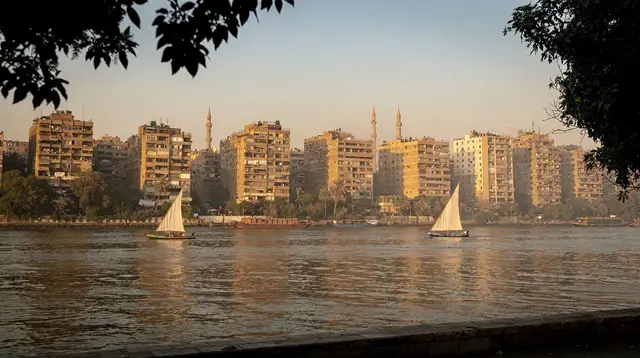
Fustat is one of the oldest parts of Cairo, generally considered the site of the city’s first Islamic-era settlement. Geographically, it sits close to Coptic Cairo, not close to Giza and not close to Tahrir. That single fact should drive how you plan the day.
A lot of first-time visitors assume the NMEC pairs naturally with the pyramids, since both involve “ancient Egypt.” In practice, Fustat and Giza are on opposite sides of a sprawling, traffic-heavy city, and stitching them into one day means two long drives instead of one focused visit. It’s the kind of plan that looks fine on a map and falls apart once you’re sitting in Cairo traffic mid-afternoon.
The sites that do sit close to the NMEC are the Coptic Cairo landmarks: the Hanging Church, the Ben Ezra Synagogue, and the Coptic Museum. A driver can move you between the NMEC and those sites in a short hop rather than a cross-city haul, which makes for a coherent half-day rather than two disjointed errands.
a combined itinerary covering the NMEC, Old Cairo, and Khan el-Khalili is built around exactly that geography, and it’s usually more efficient than arranging the NMEC as a standalone trip from a Giza-area hotel.
How much time to actually set aside
Nobody publishes a fixed visit duration that holds for everyone, and this page won’t invent one either. As a working estimate: most visitors spend somewhere around one to two hours inside the NMEC itself, with the royal mummies hall accounting for a meaningful share of that because people slow down there. Add on whatever it takes to get to and from Fustat given your hotel location and the time of day — Cairo traffic is dense for most of the daylight hours, not just at rush hour, so build in margin rather than assuming a quick in-and-out.
If you’re combining the NMEC with Coptic Cairo, a half-day is a more honest planning unit than “an hour at the museum.” Morning starts tend to work better, both for lighter traffic and for avoiding the heat if you’re visiting in summer.
If you can only pick one Old Cairo museum stop
Some itineraries genuinely don’t have room for both the NMEC and the Coptic Museum, and it’s worth being honest about which one to drop rather than rushing both. If the royal mummies themselves are the draw — the thing you came to Cairo specifically to see — the NMEC wins outright; nothing else in the city replicates that collection. If your interest runs more toward Coptic-era art, icons, and manuscripts, the Coptic Museum is the deeper collection on that specific subject, and it sits inside the walls of Coptic Cairo itself, a few steps from the Hanging Church rather than a short drive away.
Visitors who try to force both into a single rushed afternoon often report the same thing afterward: neither stop got the attention it deserved, and the drive between them ate more of the day than expected even though the two sites aren’t far apart on a map. If the choice has to be made, pick one, spend real time there, and leave the other for a future trip or a longer stay.
A day built around Old Cairo, not Giza
If the NMEC is your priority, don’t force it onto a Giza-heavy itinerary. A cleaner sequence looks like this:
| Stop | What it adds |
|---|---|
| NMEC, Fustat | Royal mummies hall, civilization-history galleries |
| Hanging Church | Coptic-era church built over a Roman gatehouse |
| Ben Ezra Synagogue | One of Cairo’s oldest synagogues |
| Coptic Museum | Coptic art and artifacts, same neighborhood |
| Khan el-Khalili (optional, later) | Bazaar stop if the day still has room |
This keeps the driving short between stops and treats the NMEC as the centerpiece it deserves to be, rather than a rushed add-on squeezed before or after a pyramids day. If you’d rather have someone else handle the routing and access, a guided visit to the royal mummies hall with transfers included removes the logistics question entirely.
For a broader look at what else sits in this part of the city, Coptic Cairo tours and things to do in Coptic Cairo cover the wider neighborhood beyond the museum stop.
Etiquette and practical notes
The NMEC is a museum, not a mosque or a church, so the dress and behavior expectations are more relaxed than at Islamic Cairo or Coptic religious sites — though modest clothing is still sensible anywhere in Cairo. Inside the royal mummies hall specifically, expect a quieter, more restrained atmosphere than the rest of the museum; it’s presented as a space for viewing human remains with some gravity, not as a photo backdrop.
Photography policies inside the mummies hall have shifted over the years and have at times been more restrictive than in the museum’s other galleries. Don’t plan around a photography rule you read in an old trip report — check the signage and staff guidance on the day.
Cash is still useful for small purchases nearby, tipping (baksheesh) is customary for guides and drivers as it is across Egypt, and if you’re arranging your own transport, a private driver or a rideshare like Uber or Careem is the simplest way to reach Fustat without navigating Cairo’s road network yourself.
The museum building itself is modern, built with step-free routes and elevators between floors, which makes it more comfortable for visitors with mobility limitations than some of the older sites nearby. Coptic Cairo’s alleys and church interiors, by contrast, involve uneven stone floors, narrow passages, and steps, so a visitor planning both stops in one day should expect the NMEC to be the easier half physically.
What tends to surprise first-time visitors is less about the mummies themselves and more about scale: the royal mummies hall is smaller and more contained than people expect after seeing it described as one of Cairo’s headline sights. There’s no sprawling exhibition to wander for hours — it’s a focused, deliberately quiet space, and visitors expecting something on the scale of the Grand Egyptian Museum’s galleries sometimes walk through it faster than planned. The rest of the NMEC, covering Egyptian civilization more broadly, is larger and easy to underestimate by comparison, so don’t budget all your time for the one hall and rush the galleries around it.
If you want the NMEC folded into a longer museum-focused day that also revisits what’s still at Tahrir, a guided tour built around the museum you actually want to see lets you choose the combination rather than following a fixed package.
Two more things worth knowing
Does the NMEC get as crowded as Giza or Tahrir?
Not in the same way. The Giza plateau and the Tahrir museum both draw heavy, near-constant tour-group traffic, and the NMEC simply doesn’t see the same volume — it’s a newer stop that hasn’t made it onto every itinerary yet, and the royal mummies hall in particular tends to feel calm rather than packed on an ordinary weekday. That can shift around public holidays, school trips, and periods when Cairo sees a spike in domestic visitors, so it’s not a guarantee, but as a baseline the NMEC is the quieter of Cairo’s three big museums.
Is the NMEC a good stop with young kids?
It depends on the individual child more than on any general rule. The civilization-history galleries are broad and visual enough to hold most kids’ attention for a while, but the royal mummies hall is, plainly, a room of human remains displayed under low light — some children find that captivating, others find it genuinely unsettling. Parents who know their kid is sensitive to that kind of exhibit sometimes visit the wider galleries and skip the mummies hall itself, or split the group so one adult goes through with the kids while another lingers longer.
The confusion, one more time, plainly
Because this is the point of the page, it’s worth stating without hedging: as of this writing, the royal mummies are in the NMEC in Fustat, not at the Egyptian Museum in Tahrir, and not at the Grand Egyptian Museum near Giza. The move happened in April 2021. Tahrir did not close, and it still holds a substantial collection of its own — see our separate coverage of the Egyptian Museum at Tahrir and the GEM for what each of those actually contains now. This page exists because that single fact — where the mummies actually are — is still one of the most commonly mixed-up details in Cairo trip planning, and getting it right changes which part of the city you should be driving to.
For a side-by-side comparison of what’s where across Cairo’s museums, our GEM versus Tahrir guide covers the other half of this picture. And if you’re still deciding how many museum half-days your Cairo trip has room for, how many days in Cairo is a useful starting point before you lock in a schedule around sightseeing tickets and transfers.
Grand Egyptian Museum and NMEC tours on GetYourGuide
Verified deep-linked GetYourGuide tours. Book through these links and we earn a small commission at no cost to you.
GetYourGuide does not provide a product photo for this activity — the image shows the meeting point, photographed by us.