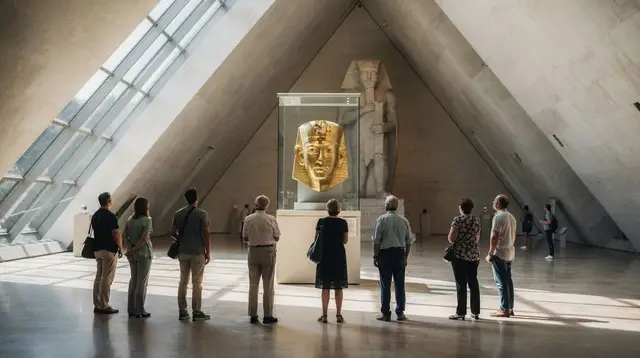
Coptic Cairo tours: the Hanging Church, Ben Ezra and the Coptic Museum
What is there to see in Coptic Cairo?
Coptic Cairo is a walled, mostly pedestrian enclave built over Roman Babylon, home to the Hanging Church, the Ben Ezra Synagogue and the Coptic Museum. It sits next to Fustat, where the National Museum of Egyptian Civilization (NMEC) now holds Egypt's royal mummies.
A walled quarter, not a stop on the Islamic Cairo route
Coptic Cairo gets folded into “Old Cairo” itineraries so often that visitors arrive expecting one long walk that covers the Citadel, Al-Azhar and Khan el-Khalili in the same stretch. It does not work that way. Coptic Cairo is a compact, mostly pedestrian enclave built over the Roman fortress of Babylon, several kilometres south of the Islamic Cairo core around the Citadel of Saladin and the Mosque of Muhammad Ali. If your driver or guide is packing both into a single morning, expect a long transfer through Cairo traffic in between, not a stroll from one to the other. This page covers only the Coptic Cairo perimeter — the Hanging Church, Ben Ezra Synagogue and Coptic Museum — and its immediate neighbour, Fustat. For the Citadel, Al-Azhar and the bazaar, see the dedicated Islamic Cairo tours guide.
The quarter takes its name from the Coptic Orthodox Christian community that has worshipped here for close to two thousand years, one of the oldest continuous Christian populations anywhere. The Roman walls and gates are still visible in places, and the narrow lanes between the churches feel distinctly different from the wider, more commercial streets of Islamic Cairo. It rewards an unhurried pace rather than a checklist walk.
When to go and what to expect at the gate
Coptic Cairo’s churches and the Coptic Museum keep daytime hours only; there is no evening opening comparable to the Giza sound and light show, and the quarter goes quiet well before sunset. Weekday mornings, shortly after opening, are noticeably calmer than midday, when tour groups converge after finishing Islamic Cairo or before heading to the airport. Friday carries its own rhythm: it is both the Muslim day of rest across Cairo and, for many Coptic residents, a day tied to church services rather than a guaranteed quiet morning for sightseeing, so it is worth checking rather than assuming Friday is automatically calmer.
Entry to the compound passes through a security checkpoint with a bag scanner, standard practice at religious and heritage sites across the city. It rarely causes more than a short queue, but it is worth building a few minutes into the schedule rather than timing a visit to the minute.
The lanes inside Coptic Cairo are cobbled and uneven in places, and the Hanging Church is reached by a flight of stone stairs with no lift alternative, so wheelchair users and anyone with limited mobility should plan for a partial visit or check ahead with a private guide about which stretches to skip. Ben Ezra Synagogue and the Coptic Museum sit on flatter ground and are noticeably easier going.
What’s inside the gates
The Hanging Church
The Hanging Church (El Muallaqa) takes its name from its position, built over the gatehouse towers of the old Roman fortress, so the nave technically hangs above the passage below. It is one of the oldest churches in Egypt and remains an active place of worship, with services still held regularly. The interior has a dark-wood iconostasis inlaid with ivory and a collection of icons spanning several centuries. It is usually the first stop on a Coptic Cairo walk, reachable by a short staircase from street level.
Ben Ezra Synagogue
A few minutes’ walk from the Hanging Church, the Ben Ezra Synagogue is the oldest synagogue in Cairo and the most tangible sign of the neighbourhood’s layered religious history — Roman fortress, Coptic churches, and a Jewish community that has largely left Egypt but left this building behind. It gained wider attention through the Cairo Geniza, a trove of medieval documents discovered stored inside it. The building itself is modest and quiet rather than grand, which is part of what makes it worth the stop.
The Coptic Museum
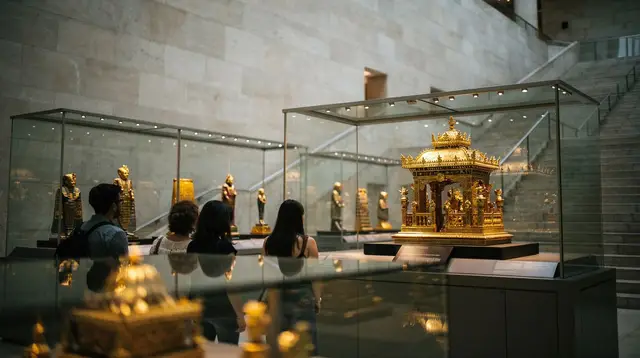
The Coptic Museum sits inside the same walled compound and holds the largest collection of Coptic Christian art anywhere, including textiles, manuscripts, woodwork and stonework spanning the transition from ancient Egyptian to Christian to early Islamic periods. It is the best place in the city to understand how those periods overlapped rather than replaced one another cleanly, and it is usually far less crowded than the Egyptian Museum or the Grand Egyptian Museum (GEM), which makes it a comfortable, unhurried visit.
Smaller churches and the old fortress walls
Beyond the three main sites, the lanes hold several smaller churches worth a glance if time allows, along with visible sections of the Roman fortress walls that gave the district its original shape. None of these need dedicated time on their own; they are part of the walk between the main stops rather than separate destinations.
Dress and etiquette in Coptic Cairo’s churches
Coptic Cairo’s churches are working places of worship, not museum exhibits, and dress accordingly:
- Cover shoulders and knees. Bring a light scarf or shawl if you are wearing sleeveless tops or shorts, since it is common to be asked to cover up at the entrance rather than turned away outright.
- Many women choose to cover their hair inside the churches as a courtesy, though enforcement is noticeably more relaxed here than at the mosques of Islamic Cairo.
- Shoes generally stay on inside the churches, unlike mosques, where footwear comes off at the door — do not assume the same rule applies in both.
- Keep voices low during active services, and check before photographing worshippers rather than assuming it is fine.
- The same modest-dress guidance applies at Ben Ezra Synagogue.
For the fuller version of these rules across mosques and churches citywide, see mosque etiquette in Cairo and what to wear in Cairo.
Where the royal mummies actually are
This is the single most common point of confusion for visitors planning a Coptic Cairo trip. The royal mummies of Egypt’s pharaohs are not at the Egyptian Museum on Tahrir Square, where guidebooks placed them for decades. They moved to the National Museum of Egyptian Civilization (NMEC) in Fustat during the Pharaohs’ Golden Parade in April 2021, a televised procession that carried 22 royal mummies across the city to their new home. If finding the mummies is a priority, plan for the NMEC, not Tahrir.
Fustat, where the NMEC sits, is the site of Egypt’s first Islamic-era capital and lies close to the Coptic Cairo gate — close enough that many private tours and drivers combine the two in a single half-day without a long transfer. The Egyptian Museum on Tahrir Square has not closed and still holds a large collection, including Tutankhamun-era items that predate the move of his full collection to the Grand Egyptian Museum (GEM) near Giza — the two coexist, and neither has replaced the other. For the specifics of the NMEC visit itself, see royal mummies at the NMEC.
How Coptic Cairo compares to its neighbours
| Site | Distance from Coptic Cairo | What it adds |
|---|---|---|
| Fustat / NMEC | Short drive or moderate walk | Royal mummies, First Islamic capital site |
| Islamic Cairo (Citadel, Al-Azhar, Khan el-Khalili) | Separate district, longer transfer | Mosques, bazaar, Ottoman and Mamluk architecture |
| Egyptian Museum (Tahrir) | Across the city centre | Tutankhamun-era pieces, older collection, no mummies |
| Giza plateau | 45–90 minutes by road | Pyramids, Sphinx, GEM |
Planning a Coptic Cairo half-day
A realistic sequence: Hanging Church, then Ben Ezra Synagogue, then the Coptic Museum, finishing with the NMEC in Fustat if time and interest allow. That is enough for one focused half-day; trying to bolt on Islamic Cairo or a full GEM visit the same morning usually means rushing one or the other given Cairo’s traffic. A private driver or Things to do in Coptic Cairo style day tour handles the transfers, but a well-organised group tour covers the same ground at a lower cost if you are comfortable on a fixed schedule.
a private day tour of Coptic Cairo and the nearby cave church is a straightforward way to see the quarter without arranging transport yourself, and it typically builds in time at each stop rather than rushing between them.
For visitors who want Coptic Cairo alongside a broader look at the city’s religious sites in one outing, a combined religion-focused tour covering both Islamic and Coptic Cairo covers more ground in a single day, at the cost of less time at any one stop — useful if you have only one day free rather than two half-days.
If Coptic Cairo is one stop among several rather than the focus of your day, a day combining Old Cairo with the Khan el-Khalili bazaar pairs the churches with shopping time, though be aware this adds the transfer to Islamic Cairo described above.
Travellers who also want the Egyptian Museum’s Tahrir collection in the same day can look at a private day tour combining the Egyptian Museum, Old Cairo and the bazaar, which covers three distinct districts and needs a full day rather than a half-day to do properly.
If you only have an hour
If time is tight — a stopover, or a Coptic Cairo stop squeezed between other plans — the Hanging Church and the Coptic Museum cover more ground per minute than Ben Ezra Synagogue. The synagogue’s interest is largely historical, tied to the story of the Cairo Geniza rather than to anything visually dense, and it is often the smallest, quickest stop of the three. Visitors who want the fullest picture skip nothing, but a genuinely tight schedule is better spent lingering at the Museum and the Hanging Church than rushing all three sites for the sake of completeness.
What surprises first-time visitors
Two things catch newcomers off guard. First, the enclave is smaller and more built-up than the phrase “walled quarter” suggests. The lanes are narrow and shaded, closer to an old residential alley than an open archaeological site, and visitors expecting sweeping views or grand plazas tend to leave disappointed, while those expecting an intimate, layered neighbourhood generally do not. Second, there is little food or drink inside the walls themselves. A handful of small vendors sell cold drinks and snacks near the entrance, but sit-down options sit outside the compound, so visitors planning a longer stay are better off eating beforehand or stepping outside the walls for lunch rather than counting on something inside.
Getting there and getting around
Coptic Cairo is reachable by Metro (Mar Girgis station sits at the gate) or by private driver or ride-hailing app such as Uber or Careem, which is the more common choice for visitors combining it with the NMEC or another stop the same day. Given how central Cairo’s traffic is to any day plan, see Cairo traffic and realistic travel times before deciding how much else to schedule around it. For getting to and from the airport or your hotel more generally, see the Cairo airport arrival guide and Uber and Careem in Cairo.
Coptic Cairo, Islamic Cairo and Fustat: frequently confused
The three sit close together on a map but represent different periods and different visiting logic. Islamic Cairo, covered separately in Islamic Cairo tours and things to do in Islamic Cairo, holds the Citadel, Al-Azhar mosque and the Khan el-Khalili bazaar — an Ottoman and Mamluk-era district with its own dress rules and its own half-day or full-day logic. Fustat, next to Coptic Cairo, holds the NMEC and the ruins of Egypt’s first Islamic-era capital. Coptic Cairo itself predates both, sitting on the Roman fortress of Babylon. Treating all three as one walkable stretch is the most common planning mistake for a first Cairo visit; budgeting them as two or three separate outings avoids a rushed, confusing day. For a wider view of how to sequence a Cairo stay, see how many days in Cairo and where to stay in Cairo.
Frequently asked questions about visiting Coptic Cairo
Is Coptic Cairo the same as Islamic Cairo?
No. Coptic Cairo is a separate, older walled quarter built on the Roman fortress of Babylon, a few kilometres south of the Islamic Cairo sites around the Citadel and Khan el-Khalili. They are usually visited on different half-days.
Where are the royal mummies now?
The royal mummies moved to the National Museum of Egyptian Civilization (NMEC) in Fustat during the Pharaohs’ Golden Parade of April 2021. They are no longer displayed at the Egyptian Museum on Tahrir Square, which remains open with its own large collection.
What should I wear to visit Coptic Cairo’s churches?
Cover your shoulders and knees at the Hanging Church, Ben Ezra Synagogue and other working places of worship. Women often cover their hair inside churches as a courtesy, though it is less strictly enforced than at mosques. Shoes generally stay on in churches, unlike mosques.
Can you combine Coptic Cairo with the NMEC in one visit?
Yes, and it is the most efficient pairing. The NMEC sits a short drive or moderate walk from the Coptic Cairo gate in Fustat, so a private driver or guided tour typically covers both in a half-day without doubling back across the city.
Do I need a guide for Coptic Cairo?
Not strictly, since the churches and museum are self-explanatory with signage, but a guide adds real value here because the layered history (Roman fortress, early church, synagogue, mosque nearby) is easy to misread without context.
How much time does Coptic Cairo need?
Budget two to three hours for the Hanging Church, Ben Ezra Synagogue and Coptic Museum at an unhurried pace, plus 45 to 90 minutes more if you add the NMEC the same morning.
Is Coptic Cairo included in Old Cairo tours?
Often yes. Tours labelled “Old Cairo” or “Coptic Cairo” typically cover the same walled enclave; some bundle in Khan el-Khalili or the Egyptian Museum, which are separate districts, so check the itinerary before booking.
What time of day is Coptic Cairo least crowded?
Weekday mornings shortly after opening are usually the quietest window, before tour groups arrive from Islamic Cairo or Giza. Midday and early afternoon tend to be busiest, and Friday brings its own rhythm rather than a guaranteed lull, given its dual role as the Muslim day of rest and a day of church activity for many Coptic residents.
Is Coptic Cairo accessible for visitors with limited mobility?
Partially. The lanes are cobbled and uneven, and the Hanging Church is reached by a flight of stone stairs with no lift. Ben Ezra Synagogue and the Coptic Museum sit on flatter ground and are easier to reach, so a partial visit focused on those two is a reasonable option for visitors with mobility limitations.
Islamic and Coptic Cairo tours on GetYourGuide
Verified deep-linked GetYourGuide tours. Book through these links and we earn a small commission at no cost to you.
GetYourGuide does not provide a product photo for this activity — the image shows the meeting point, photographed by us.