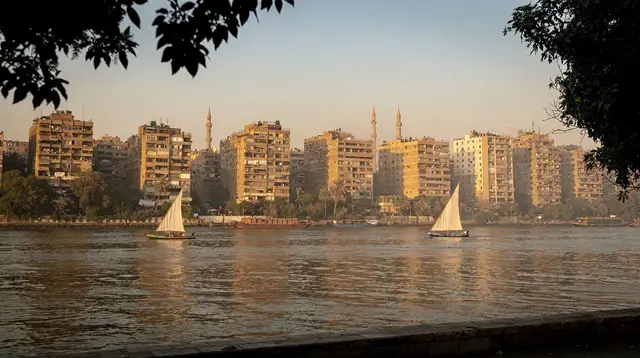
Mamluk Cairo in five buildings
I keep coming back to the same five buildings when someone asks me where to start with Islamic Cairo, and it took me three trips to work out why these five and not the others. It is not that they are the oldest or the biggest. It is that no two of them are doing the same architectural job, and walking between them in order tells you something the guidebooks tend to flatten into a list of dates.
I am leaving out Coptic Cairo here on purpose — the Hanging Church, Ben Ezra Synagogue and the Coptic Museum have their own history, and mixing the two quarters into one walk does justice to neither. This is the sultans-and-khedives version of the city, not the religious one, and I am not going to get into mosque timings or the rhythm of Friday here either. Just the buildings, and what makes each one worth the detour.
The Citadel and the mosque that sits on top of it
I put these two together because they were built four centuries apart and still read as one gesture. Saladin started the Citadel of Saladin in the twelfth century as a fortress on the limestone spur east of the old city — thick walls, a defensive footprint, the practical architecture of a ruler who needed to hold Cairo, not decorate it. What you actually photograph up there is the Mosque of Muhammad Ali, added on the same hill in the nineteenth century by an Ottoman-Albanian governor who wanted Cairo to look toward Istanbul rather than back at its own Mamluk past. Its silver domes and slim minarets are Ottoman in shape, not Mamluk, and standing between the two buildings is the fastest way I know to feel six centuries of change in about two hundred metres of walking.
The view from the terrace, over the minarets of the old city toward the Muqattam hills, is the reason most people go up. The architectural contrast is the reason I keep going back.
Al-Azhar, the one date that matters
Al-Azhar Mosque is the single fixed point in this whole walk: founded in 970, which makes it the oldest working mosque in the city and one of the oldest continuously functioning universities anywhere. I am not going to guess at dates for the other four buildings here, because guessing is how bad information spreads, but 970 is solid and it is worth holding onto as your anchor for everything else.
What strikes me architecturally is less the age than the layering. Al-Azhar has been expanded, restored and added to by ruler after ruler for over a thousand years, so what you see today is a composite — a Fatimid core with later gates, courtyards and teaching halls stitched on. It does not look like one building from one century. It looks like a working institution that kept growing, which is exactly what it is.
Sultan Hassan, the stonework lesson
If Al-Azhar is about accumulation, the Mosque of Sultan Hassan is about a single, enormous, unified idea executed in stone. It is fourteenth-century Mamluk architecture at its most confident: a scale that still feels oversized next to the buildings around it, and stone-cutting precision that holds up under close inspection in a way carved wood or painted plaster does not. I find this the building that best answers the question of what “Mamluk architecture” actually means as a style rather than a label — the proportions, the way the entrance portal dwarfs the person walking through it, the restraint in decoration compared to what came later.
It is also, in my experience, the quietest of the five. Fewer tour groups make it this far south of Al-Azhar, which makes it easier to actually look at the stonework rather than navigate around a crowd.
Al-Muizz Street, the corridor version
Al-Muizz Street is not one building, it is a stretch of Mamluk and Fatimid facades lined up along a single pedestrian corridor, and I am including it as the fifth entry because nowhere else in the city lets you compare so many building styles in one walk without getting in a car. Sabils, madrasas and merchant houses sit shoulder to shoulder here, and the density is the point — you can see how ornamentation, window screens and doorway proportions shifted from one sultan’s reign to the next just by walking a few hundred metres.
Khan el-Khalili, the bazaar, sits right off this street, and it is worth a stop for the atmosphere and the shopping, but I have not counted it among the five here — it is a market, not an architectural statement, and treating it as one blurs what actually makes the other four buildings worth the trip.
What to wear, and what to skip
All of these except Al-Muizz Street are active mosques or a mosque complex, and the dress code is not optional. Shoulders and knees covered for everyone, women cover their hair before entering the prayer halls, and shoes come off at the door of each mosque — carry a bag for them, most sites do not have reliable storage. None of this applies on Al-Muizz Street itself, which is an open pedestrian street, but it applies again the moment you step into any of the madrasas along it.
I would skip trying to do all five in one afternoon. The Citadel alone takes an hour if you actually look at the view, and Sultan Hassan rewards slow walking more than any of the others. Two half-days, with the Citadel and Muhammad Ali Mosque as one outing and Al-Azhar, Sultan Hassan and Al-Muizz Street as a second, worked better for me than trying to compress it all into one long day in traffic.
If the scale of these buildings gets you interested in what else survives from Egypt’s layered history, the artifacts that once filled rooms like these now sit largely in museums rather than in situ — a guided museum tour picked to match what you actually want to see is a reasonable way to close that gap, and an Egyptian Museum private guided tour at Tahrir covers the pre-Islamic end of the timeline these five buildings pick up from. A private guide who knows Islamic Cairo specifically is worth hiring if you want more than the architecture — the social and political history behind each ruler’s choices is a longer conversation than a plaque can hold.
Mamluk and Islamic Cairo, questions I get asked
Do I need a guide to visit these five buildings?
No, all five are open to independent visitors and reachable by taxi, Uber or Careem from central Cairo or Zamalek. A guide adds context on the political history behind each building, which the architecture alone does not explain, but it is not required to get in.
Is Khan el-Khalili one of the five buildings?
No. Khan el-Khalili is a bazaar, not a building, and it sits just off Al-Muizz Street. It is worth a stop for its own reasons, covered separately in this Khan el-Khalili guide, but it is not part of this architectural walk.
What should I wear to visit the Citadel and the mosques?
Shoulders and knees covered, and shoes off at the entrance of each mosque. Women cover their hair before entering the prayer halls. Al-Muizz Street itself is an open street with no dress requirement, but the madrasas along it follow the same rule as the mosques.
How much time should I set aside for this walk?
I would not try all five in one visit. The Citadel and Muhammad Ali Mosque make a reasonable half-day on their own, and Al-Azhar, Sultan Hassan and Al-Muizz Street work better as a separate half-day walked at a slower pace, ideally starting early before the midday heat and the crowds along Al-Muizz Street build up.
Why does Al-Azhar get a date and the other four don’t?
Al-Azhar’s founding in 970 is well documented and consistently dated. The construction history of the Citadel, the Mosque of Muhammad Ali, Sultan Hassan and the buildings along Al-Muizz Street is layered, restored and expanded across centuries, and reducing that to a single year would flatten a more complicated story rather than clarify it.
Does this walk cover Coptic Cairo too?
No, deliberately not. The Hanging Church, Ben Ezra Synagogue and the Coptic Museum sit in a different part of the old city with a different history, and mixing the two into one itinerary tends to shortchange both. A separate write-up on Coptic Cairo’s history covers that quarter on its own terms.
Can I combine this with a visit to Islamic Cairo’s other sights?
Yes — this is a good starting checklist for a broader visit, and a wider Islamic Cairo tour or the things to do in Islamic Cairo overview covers more sites than the five ranked here, including smaller madrasas and sabils that did not make this particular list. An Islamic and Coptic Cairo in one day itinerary exists too, though I still think two separate visits work better than one long compressed day.
Is it worth hiring a private driver for this walk, or is it walkable?
Al-Azhar, Sultan Hassan and Al-Muizz Street are close enough to walk between once you are in the old city, but getting there from Zamalek or where you’re staying in Cairo is faster with a driver given the traffic. A private driver or a private versus group tour comparison is worth reading before you decide how to structure the day, and it is worth checking photography rules at Egyptian sites before you go, since some interiors restrict tripods or flash.
tours.Culture
Verified deep-linked GetYourGuide tours. Book through these links and we earn a small commission at no cost to you.
GetYourGuide does not provide a product photo for this activity — the image shows the meeting point, photographed by us.