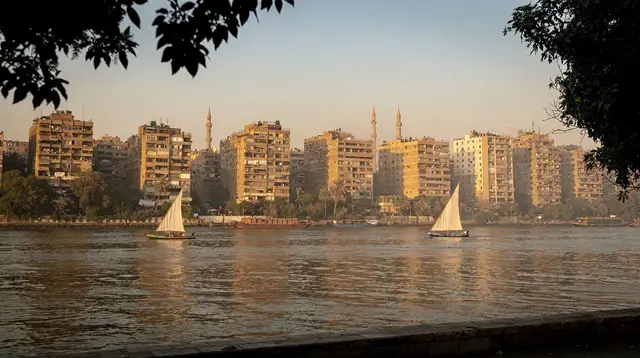
An older necropolis, a different pace
Most visitors to Cairo picture the three great pyramids at Giza and stop there. Saqqara sits further south, on the edge of the desert above the ancient capital of Memphis, and it is a different kind of site: older, quieter, and spread across a much larger area of tombs, temples and one unmistakable stepped pyramid. If Giza is the postcard, Saqqara is the place that explains how the postcard came to exist.
The two necropolises are close enough to combine, but they are not the same site, and the monuments do not overlap. Getting the names and locations right matters, because the confusion is common: the Step Pyramid is at Saqqara, not Giza, and the famous Bent Pyramid is at Dahshur, not anywhere else. Mixing them up is the single most frequent mistake in trip planning around Cairo.
Clearing up the confusion first
Two names get moved around constantly in reviews and forum posts, so it is worth stating plainly:
- The Step Pyramid of Djoser stands at Saqqara. It is not at Giza, and Giza has no step pyramid.
- The Bent Pyramid and the Red Pyramid, both built for the pharaoh Sneferu, stand at Dahshur, a separate site a short drive south of Saqqara. There is no Bent Pyramid anywhere else in Egypt.
If your plan is “see the pyramids,” it helps to know which ones you mean. For the three famous pyramids of Khufu, Khafre and Menkaure plus the Great Sphinx, see the Giza guide; this page covers the older, quieter group to the south. A side-by-side comparison of the two necropolises, Giza vs Saqqara, is worth a look if you are still deciding how to split your days.
Why Saqqara comes first, historically
The Step Pyramid of Djoser, standing at Saqqara some 30 km south of the Giza plateau, is widely considered the oldest large-scale stone monument in the world, built for the Third Dynasty pharaoh Djoser roughly a century before the Giza pyramids. It is not a smooth-sided pyramid but a stack of six mastaba-like tiers, rising in stages rather than sloping to a point. Around it, an extensive funerary complex of courtyards, colonnades and dummy buildings sits inside a stone enclosure wall, much of it excavated and partly restored in the twentieth century.
Nearby, the Serapeum of Saqqara holds the underground galleries where sacred Apis bulls were entombed in massive granite sarcophagi, one of the more atmospheric and less crowded corners of the site. Saqqara also spreads across a wide desert plateau with dozens of other tombs, some newly opened to visitors in recent years, which is part of why archaeologists keep finding more here than at Giza. Readers curious about the pharaoh behind the monument can find more background in who was Djoser, and a closer, room-by-room look at the Step Pyramid complex itself is in the dedicated Step Pyramid of Djoser guide.
Djoser’s monument, the pyramid fields of Dahshur, and Memphis together form part of the same UNESCO World Heritage designation as Giza: “Memphis and its Necropolis – the Pyramid Fields from Giza to Dahshur,” inscribed in 1979. In practice this means the whole stretch from Giza down through Saqqara to Dahshur is treated as one archaeological zone, even though each part has its own character and its own gate.
Dahshur: the pyramids that predate Giza’s smooth sides
Dahshur lies a short further drive south of Saqqara and is where Sneferu, Khufu’s father, worked out how to build a true smooth-sided pyramid. His first attempt, the Bent Pyramid, changes angle partway up, the visible result of an engineering correction made mid-construction. His second attempt, the Red Pyramid, named for the reddish tone of its limestone, is the earliest successful true pyramid in Egypt and is open for visitors to walk inside through a narrow descending passage.
Dahshur draws a fraction of Saqqara’s visitors and a small fraction of Giza’s. There are stretches of open desert here where you may be the only car in sight, which is the main reason to bother with the extra drive. For more detail on both pyramids and what walking inside the Red Pyramid actually involves, see the Dahshur guide.
Memphis: what is left of the ancient capital
Memphis, at the modern village of Mit Rahina, was the administrative capital of ancient Egypt for long stretches of its history, though almost nothing of the city itself survives above ground; the Nile floodplain buried most of it under silt over the centuries. What remains today is effectively an open-air museum: a colossal limestone statue of Ramesses II, now displayed lying down under cover, an alabaster sphinx, and a scatter of other statuary collected from the site.
It is a brief stop compared with Saqqara or Dahshur, more of a pause between the two, but it rounds out the story of the region: this is the capital these pyramid fields were built to serve. A fuller account of the statue and the site’s history is in the Memphis and the Colossus of Ramesses II guide.
How a combined day works
Saqqara, Dahshur and Memphis sit close enough together, all south of Giza on the west side of the Nile, that a private car can cover all three in one day without doubling back across Cairo traffic. The order most drivers use is Saqqara first (it has the most ground to cover and the most shade-free walking), Dahshur second (a short hop further south), and Memphis last (a brief stop on the way back toward Cairo or Giza).
Start early. This is true everywhere around Cairo, but it matters more here because the sites are outdoors and largely unshaded, and because Saqqara alone can easily fill a morning if you want to see the Step Pyramid complex properly and step into the Serapeum. Leaving your hotel in Cairo or Giza by mid-morning at the latest keeps the day workable; leaving at opening time keeps it comfortable.
What this day does not include is Giza itself. Trying to add the three great pyramids and the Sphinx to the same itinerary as Saqqara, Dahshur and Memphis makes for a rushed, exhausting day with too much driving and too little time at any one site. Most visitors do Giza on one day (often paired with the Grand Egyptian Museum) and Saqqara-Dahshur-Memphis on another. A rundown of other combined itineraries out of the capital is in day trips from Cairo, and the tour options for this specific route are collected on the Saqqara, Memphis and Dahshur tours guide.
a half-day private tour covering the Step Pyramid and Memphis is the simplest version of this trip if your time in Cairo is limited and you want to leave Dahshur out. For the fuller day, a combined day trip taking in the pyramid fields and Memphis together covers the same route described above.
Traffic and timing, honestly
Cairo’s traffic is dense at almost any hour, but the route south toward Saqqara avoids the worst of the central Cairo and Giza-plateau congestion once you clear the immediate city. Even so, treat 45 minutes as an optimistic figure and 75 minutes as a realistic one for the drive from central Cairo or Giza hotels, and add another 20-30 minutes to continue on to Dahshur. A private driver, arranged through your hotel or a private-driver service, makes the day considerably easier than trying to string together taxis between three separate sites. These same driving-time margins apply across most day trips out of the capital; the Cairo traffic and realistic travel times guide covers the pattern in more detail.
| Stop | Typical time on site | Notes |
|---|---|---|
| Saqqara (Step Pyramid complex + Serapeum) | 1.5-2.5 hours | The largest and most varied stop, walking outdoors |
| Dahshur (Bent and Red pyramids) | 45-75 minutes | Optional but recommended for the quiet |
| Memphis (Mit Rahina open-air museum) | 30-45 minutes | Brief, shaded pavilion for the Ramesses II statue |
For travellers who want to combine the desert history with a Nile evening, some operators bundle this itinerary with a felucca sail or dinner cruise back in Cairo; a day covering Saqqara, Memphis and Dahshur followed by a Nile dinner cruise is one way to close out the day without arranging the cruise separately. If you would rather choose your own add-ons, a Saqqara, Memphis and Dahshur itinerary with optional felucca add-ons leaves that decision for the day itself.
What to skip or shorten
Not every corner of Saqqara needs a visit on a first trip. The wider plateau holds dozens of minor tombs and mastabas that reward repeat visitors and anyone with a serious interest in Old Kingdom archaeology, but on a combined day with Dahshur and Memphis, most travellers do well to concentrate on the Step Pyramid complex and the Serapeum, then move on. Guides sometimes offer optional stops at a papyrus workshop or a carpet school on the way back to Cairo; these are commercial detours rather than historical sites, and they are easy to decline if you would rather use the time at the pyramid fields instead.
If your schedule is genuinely tight, Dahshur is the piece most people cut, since Saqqara alone already covers the “step pyramid” story and Memphis is a short detour rather than a destination in itself. Cutting Saqqara to add Dahshur instead is less common advice, but for travellers who have already toured Saqqara on a previous trip and want the quieter Bent and Red pyramids without a repeat visit, some operators run a newer-tombs itinerary; a private tour focused on recently opened Saqqara tombs with a farm lunch stop is built around exactly that angle.
Practical notes for the day
There is little shade across Saqqara’s open ground, and the walk between the ticket area, the Step Pyramid enclosure and the Serapeum covers real distance on uneven sand and stone. Bring water, a hat, and sun protection regardless of season; in June through August the exposed walking makes an early start close to essential rather than optional. Photography is generally allowed at all three sites, though rules can change site to site and year to year, and paying a small tip to site guards who point out a good angle or a rarely-opened chamber is common practice, part of the wider culture of baksheesh across Egyptian sites; the baksheesh and tipping in Egypt guide sets out roughly what to carry and when. For the specific rules around cameras, tripods and site fees, see photography rules at Egyptian sites.
As with anywhere around Cairo, dress modestly and comfortable for walking rather than for the heat alone; shoulders and knees covered is the safer default even though none of these three sites are religious buildings in active use. Cash in Egyptian pounds is useful for small tips and any incidental purchases along the way, since card acceptance thins out once you leave hotels and city-centre restaurants.
Saqqara, Dahshur and Memphis: frequently asked questions
Is Saqqara worth visiting if I’ve already seen Giza?
Yes. Saqqara is a different site with a different story: the Step Pyramid predates Giza’s pyramids, the layout is more spread out and less crowded, and the Serapeum’s underground galleries have no equivalent at Giza. Many repeat visitors to Cairo rate Saqqara above Giza precisely because it is quieter.
Where is the Bent Pyramid?
The Bent Pyramid, along with the Red Pyramid, stands at Dahshur, a separate site a short drive south of Saqqara. It is not at Giza and not at Saqqara itself, though the three sites are often visited on the same day.
Can I combine Saqqara, Dahshur and Memphis with Giza in one day?
It is possible in theory but not recommended. Each stop deserves real time, and the combined driving and walking across four sites in one day usually means rushing all of them. Most itineraries split Giza (plus the Grand Egyptian Museum) into one day and Saqqara, Dahshur and Memphis into another.
How much walking is involved at Saqqara?
More than at a single monument. The Step Pyramid complex, its surrounding enclosure, and the separate approach to the Serapeum cover a fair distance across open, largely unshaded ground, so comfortable shoes and sun protection matter more here than at a compact site.
Is there anything left to see at Memphis itself?
Very little of the ancient city survives above ground, since the Nile floodplain buried most of it. What remains is effectively a small open-air museum: a colossal limestone statue of Ramesses II under a shaded pavilion, an alabaster sphinx, and a scatter of other statuary. It is a brief stop, typically 30-45 minutes.
Do Saqqara, Dahshur and Memphis have separate tickets from Giza?
Yes. Each site has its own admission arrangement, separate from the Giza plateau and separate from each other in most cases. A private guide or driver typically handles entry logistics as part of the day; check the specific tour page for what is included before booking.
Is Saqqara suitable for a half-day if I’m short on time?
Yes, Saqqara alone can be done in half a day, focused on the Step Pyramid complex and, if time allows, the Serapeum. Adding Dahshur and Memphis turns it into a full day, so a half-day version means picking Saqqara over the other two.
Do I need a guide, or can I visit independently?
Both are possible. A private driver with a guide makes the logistics between three separate sites considerably easier and adds historical context, particularly useful at Saqqara’s less obviously labelled areas. Independent visits with a hired driver and no guide are also common for travellers who prefer to explore at their own pace.