Memphis and the Colossus of Ramesses II
What is there to see at Memphis, and is it worth the stop?
Memphis, at Mit Rahina, is an open-air museum built around a colossal limestone statue of Ramesses II lying under a shelter, plus a smaller alabaster sphinx and scattered stonework. It was the capital of ancient Egypt, not a pyramid field, and it is best added as a short final stop after Saqqara and Dahshur rather than visited on its own.
An open-air museum, not a pyramid field
Memphis sits at the modern village of Mit Rahina, roughly 20 minutes south of Saqqara by road, on the west bank of the Nile. For close to two thousand years it was the capital of ancient Egypt, the administrative and religious centre the pyramid fields at Saqqara and Dahshur were built to serve. Almost nothing of the ancient city survives above ground today. What remains is a small, fenced open-air site holding a handful of pieces pulled from the ruins, arranged around a covered hall.
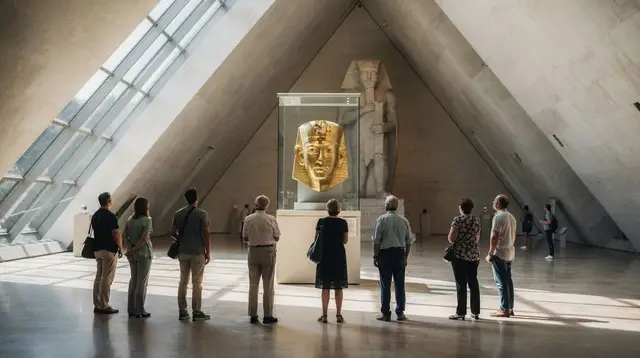
That hall is the reason anyone stops here: it shelters a colossal limestone statue of Ramesses II, lying on its back, missing its lower legs, and still enormous even reduced to a torso and head. A raised walkway lets visitors circle it at close range. Outside, in an open yard, sits a smaller alabaster sphinx, weathered but intact, along with scattered fragments of statuary and stelae. That is essentially the whole visit. There is no temple complex to walk through, no pyramid to climb toward, no ticket booth queue to speak of. Set expectations accordingly: this is a 20 to 40 minute stop, not a half-day site.
The confusion worth heading off early: Memphis is not Saqqara, and it has no pyramids of its own. The Step Pyramid of Djoser belongs to Saqqara, a separate site a short drive north. The Bent Pyramid and Red Pyramid, both built under Sneferu, belong to Dahshur, further south again. Memphis contributes the human, historical layer to the same route — the city these monuments were built to serve — rather than another monument to climb or photograph from a distance. Travellers who arrive expecting pyramids at Memphis are usually the ones who leave disappointed; travellers who arrive expecting a statue in a shed are usually satisfied.
Why the capital left almost nothing behind
Memphis was founded, by tradition, around the unification of Upper and Lower Egypt, and it functioned as Egypt’s political centre for long stretches of the pharaonic period, with temples to Ptah among its major religious buildings. Its decline had practical causes rather than dramatic ones: the Nile’s course shifted over the centuries, the city’s mudbrick structures eroded, and later builders in Cairo and elsewhere quarried its stone for their own projects. By the time European travellers began recording the site in the 19th century, the ancient capital had been reduced to mounds, scattered blocks, and a scatter of statuary half-buried in silt and palm groves.
What visitors see today is the result of excavation and consolidation around a few of the more intact pieces, not a reconstructed city. The palm-shaded grounds around the colossus hall give a sense of the setting more than the scale — Memphis in its prime covered a large area, most of it now under the modern village and farmland of Mit Rahina, unexcavated and likely to stay that way. This is worth knowing before arrival, because it resets the expectation from “ancient capital to explore” to “one striking object worth a short stop.”
The colossus itself
The statue is the point of the visit, so it is worth a moment’s context. It depicts Ramesses II, one of the longest-reigning and most prolifically self-commemorating pharaohs, carved from a single block of limestone at a scale meant to be seen from a distance rather than examined for fine detail. Displayed horizontally under its shelter, with the lower legs missing, it is still large enough that the raised walkway is necessary to take in the whole figure. A companion piece of comparable scale and subject once stood upright in Cairo’s Ramesses Square before being relocated away from the city; the Memphis colossus has remained at the original site, sheltered rather than moved.
Beside the hall, the open yard holds an alabaster sphinx, smaller than the Great Sphinx at Giza but well preserved, along with an assortment of stone fragments, statue bases, and inscribed blocks gathered from the surrounding ruins. None of it demands the time that Saqqara’s tombs or Dahshur’s pyramids do. Most visitors walk the loop, photograph the colossus from a few angles, and move on within half an hour.
Where Memphis fits on the day
Memphis works as the closing stop on a half-day loop that starts with Saqqara and continues to Dahshur, not as a standalone excursion. The logic is straightforward: Saqqara has the most ground to cover and benefits from an early start before the heat and the midday light flatten photographs; Dahshur follows, with its own driving time between the Bent and Red Pyramids; Memphis closes the loop as a short, mostly shaded final stop before the drive back toward Giza or central Cairo.
Reversing the order rarely helps. Starting at Memphis burns the coolest part of the morning on the smallest site, then pushes the more demanding walking at Saqqara into the heat of midday. A private driver familiar with the route will usually suggest the Saqqara-Dahshur-Memphis sequence without being asked; it is worth confirming it in advance if booking a driver directly rather than a set tour.
Realistic timing for the full loop, door to door from a Cairo or Giza hotel: half a day, with driving between the three sites adding up faster than the distances suggest, since none of them are directly connected and Cairo-area traffic affects the return leg as much as the outbound one. See Cairo traffic and realistic travel times before setting expectations on a tight schedule.
Getting there: driver, not public transport
There is no practical public transport route linking Saqqara, Dahshur and Memphis to each other or back to Cairo on a schedule a visitor could rely on. The three sites are rural, spread out, and not set up for independent arrival by taxi hailed on the spot — a taxi that drops a visitor at Memphis is unlikely to be waiting when the visit ends. A private driver for the day, or a small-group or private tour that already bundles the three sites, is the standard approach, and for good reason: it removes the need to negotiate onward transport at each stop and keeps the order and pacing under the visitor’s control. See hiring a private driver in Cairo for how that arrangement typically works, and private vs group tours in Cairo for how the two approaches compare on this particular route.
A handful of multi-day Cairo tours fold a Saqqara-Dahshur-Memphis half-day into a longer itinerary alongside Giza, Islamic Cairo and other city sights. For a broader stay that includes this route without arranging it separately, a booking such as a five-day Cairo tour that covers the pyramid fields south of Giza or a three-day Cairo highlights itinerary built around the major sites typically includes this half-day as one segment among several, checked on the current listing for exactly what is included before booking.
What to skip, what to keep brief
Given the modest scale of the site, a few honest notes for planning:
- Do not expect a walkable ancient city. The vast majority of Memphis lies unexcavated under the modern village; the visitable area is a fenced enclosure around a hall and a yard.
- Photography is quick. The colossus and the sphinx are the two subjects; there is no long trail of monuments to work through as at Saqqara.
- Shade is limited outside the hall. The colossus hall itself is covered, which makes Memphis a reasonable spot to pause out of direct sun before the drive back, but the open yard is not shaded.
- There is little for children beyond the statue itself. Families doing the full Saqqara-Dahshur-Memphis loop should budget the extra stop as a short break rather than a highlight, and can treat it as the easiest of the three to shorten if energy runs low.
Memphis, Saqqara and Dahshur: the same UNESCO listing
Memphis, Saqqara and Dahshur are not three unrelated attractions that happen to sit near each other. All three, together with the Giza plateau, fall inside a single UNESCO World Heritage listing inscribed in 1979: Memphis and its Necropolis – the Pyramid Fields from Giza to Dahshur. The listing recognises the historical relationship between the pyramid fields and the capital city they served, which is the same relationship that makes the half-day loop worth doing as one trip rather than three separate outings. Understanding that connection also explains why Memphis, despite having no pyramids, is grouped with sites that are almost entirely pyramids: it is the capital these monuments belonged to, not a fourth pyramid field.
| Site | What it is | Typical time on site |
|---|---|---|
| Saqqara | Pyramid field, Step Pyramid of Djoser | 1.5–2.5 hours |
| Dahshur | Pyramid field, Bent and Red Pyramids | 1–1.5 hours |
| Memphis (Mit Rahina) | Open-air museum, colossus of Ramesses II | 20–40 minutes |
For the architectural detail on the pyramids themselves, see the Step Pyramid of Djoser and the Bent and Red Pyramids at Dahshur — this page deliberately stays with Memphis rather than repeating that ground.
Combining with Giza on the same trip
Some visitors ask whether Saqqara, Dahshur and Memphis can be combined with the Giza plateau in a single day. It is physically possible with an early start and a private driver, but it makes for a long, tightly scheduled day rather than a relaxed one, and it typically means seeing Giza either very early or in the afternoon heat. Most visitors get a better experience splitting the two: Giza and the Grand Egyptian Museum as one day, Saqqara-Dahshur-Memphis as a separate half-day. For a side-by-side comparison of what each cluster involves, see Giza vs Saqqara.
For visitors building a short Cairo stay around this and other half-day options, day trips from Cairo and one day in Cairo both give a sense of how the timing works alongside the city’s other sites. A tour built specifically around lesser-visited stops, such as a Cairo itinerary focused on quieter sites away from the main crowds, sometimes routes through Memphis for exactly this reason: it is one of the few sites near Cairo that rarely feels crowded. Travellers who prefer a more offbeat framing of the same general area can also look at a Cairo tour built around unusual or lesser-known stops, though it is worth checking the exact stop list before booking, since not every “unusual” itinerary includes Memphis specifically.
Practical notes before heading out
No fixed ticket price or opening hours are given here — check the current listing on the tour or transport option used, since both can change. Bring water, since shade is limited outside the colossus hall, and expect the same general conditions as Saqqara and Dahshur: dusty ground, uneven surfaces in places, and stronger sun from late morning onward. A private driver who already knows the loop will typically time the Memphis stop to fall in the shoulder of the day, after Saqqara’s heavier walking and before the return drive into Cairo or Giza traffic.
Memphis and the colossus: questions before you go
Is Memphis the same as Saqqara?
No. Saqqara is the pyramid field with the Step Pyramid of Djoser. Memphis, at the village of Mit Rahina a short drive away, was the ancient capital itself, and today it is a small open-air museum centred on the colossal statue of Ramesses II. They are separate stops on the same half-day route.
How much time do I need at Memphis?
Most visitors spend 20 to 40 minutes. The site is compact: one covered hall with the colossus, an open yard with an alabaster sphinx and assorted statuary, and little else. It works as a quick add-on, not a destination in its own right.
In what order should I visit Saqqara, Dahshur and Memphis?
Saqqara first, since it has the most ground to cover and the heat builds through the morning. Dahshur second, for the Bent and Red Pyramids. Memphis last, as a short, shaded stop to close the loop before heading back toward Cairo or Giza.
Can I reach Memphis by taxi or public transport?
It is possible but impractical. The three sites sit apart from each other with no useful public transport link, and taxis rarely wait around for a return trip from a rural village. A private driver or a private/small-group tour that covers all three is the realistic option.
Is the Ramesses II statue the original, or has it been moved?
The statue at Memphis is displayed lying on its back inside a purpose-built shelter at the original site, not standing. A twin of comparable scale once stood in Cairo’s Ramesses Square before being relocated; the Memphis colossus itself has stayed at Mit Rahina.
Is Memphis part of the same UNESCO listing as Giza?
Yes. Memphis, Saqqara and Dahshur fall within the UNESCO World Heritage listing inscribed in 1979 as Memphis and its Necropolis – the Pyramid Fields from Giza to Dahshur, which also covers the Giza plateau.
Does Memphis get crowded?
Less than Giza or Saqqara. It draws a fraction of the visitor numbers, partly because it has no pyramids and partly because many day-trip itineraries treat it as an afterthought rather than a planned stop.
Should I skip Memphis if I am short on time?
If a private driver already has Saqqara and Dahshur on the route, the detour to Memphis adds relatively little driving and is worth the half hour. If time is genuinely tight, it is the one of the three that can be dropped without losing much.
Saqqara, Memphis and Dahshur tours on GetYourGuide
Verified deep-linked GetYourGuide tours. Book through these links and we earn a small commission at no cost to you.
GetYourGuide does not provide a product photo for this activity — the image shows the meeting point, photographed by us.