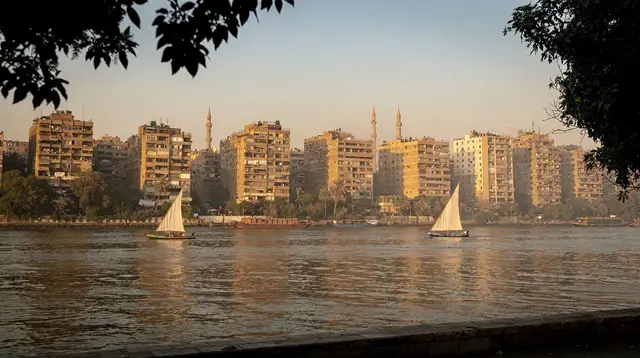
A megacity, read one district at a time
Cairo is not a single sight you tick off in an afternoon. It is a megacity of roughly 20 million people spread along both banks of the Nile, and the district you sleep in shapes every day that follows. Downtown Cairo, Zamalek, Garden City and Heliopolis are the areas visitors actually book hotels in, and each puts you at a different distance from the airport, the river and the road out to Giza. This page covers Cairo as a base — where to stay, how to arrive, how to move around. The old quarters within the city, Islamic Cairo and Coptic Cairo, have their own pages with the sites, mosques and churches worth the detour; this page sends you there rather than repeating that ground.
The practical confusion to clear up early: there is no single “Cairo visit.” You will spend some days inside the city and some days on excursions to Giza, Saqqara or further afield, and a private driver — or a mix of metro, Uber and Careem — is how those pieces connect. Traffic is heavy for most of the day, so plans built around exact clock times rarely survive contact with the ring road.
Arriving: Cairo International and the road to your hotel
Cairo International Airport (CAI) sits in Heliopolis, in the city’s north-east, and is where almost every international flight lands. A smaller airport, Sphinx International (SPX), sits west of Giza and handles a limited number of flights, mostly useful if you are heading straight to a Giza hotel. From CAI, the drive into Downtown or Zamalek generally runs 30 to 60 minutes; the drive out to a hotel in Giza runs 60 to 90 minutes, depending on the time of day and how the traffic is moving. Neither figure is a promise — Cairo’s roads are dense from mid-morning through evening, and an arrival during rush hour can push either transfer longer. See our Cairo airport arrival guide and airport transfer options for how to book a fixed transfer rather than negotiate one at the curb.
Because Heliopolis sits near CAI, a first or last night there can shave real time off a transfer, though it puts you further from the river and the museums. Most visitors instead choose Downtown, Zamalek, Garden City or Giza and accept the longer airport run in exchange for a more central base for the rest of the trip.
Arrival itself can be slow before you even reach the car: immigration queues at CAI vary by time of day and by how many wide-body flights have landed close together, and travellers with limited mobility should budget extra time for the walk between gate, immigration and the arrivals hall, since moving walkways and lifts are inconsistent across terminals. A fixed, pre-booked transfer removes one variable from an already unpredictable first hour — you are not negotiating a fare or hunting for a driver holding a sign in a crowded arrivals area after a long flight.
Downtown, Zamalek, Garden City and Heliopolis
Downtown Cairo is the historic 19th-century core — wide boulevards, faded belle-époque buildings, Tahrir Square and the Egyptian Museum. It is central, walkable in patches, loud, and close to the Nile Corniche. It suits travellers who want street life and easy access to museums and the river without paying Zamalek prices.
Zamalek occupies an island in the Nile, reached by bridge from Downtown. It is quieter, leafier and more residential, with a concentration of cafés, restaurants and mid-to-upper-range hotels. A walk along the Zamalek riverbank, described in our Nile Corniche walking guide, is a low-key way to spend an evening between excursion days.
Garden City sits south of Downtown, between the Nile and the old British and diplomatic quarter. It is smaller and calmer than Downtown, with a cluster of well-known hotels overlooking the river, and it keeps the museum and the Corniche within easy reach.
Heliopolis is the district closest to CAI, built up as a planned garden suburb in the early 20th century. It is furthest from the river-facing sights and from Giza, so it works best as an airport-adjacent night rather than a full-trip base, or for travellers with early flights.
None of these four districts is close to Giza. If the pyramids are your main reason for coming, a hotel on the Giza plateau itself — with the pyramids visible from the window — is a different, equally common choice; see where to stay in Cairo for how the trade-offs compare.
Downtown deserves an honest note alongside the description above: its belle-époque buildings are often faded rather than restored, side streets can smell of exhaust and street food in equal measure, and the noise from car horns runs late into the evening. None of that makes it unpleasant, but travellers picturing a polished old-town district will find something rougher and more lived-in, and that is part of what makes it interesting rather than a flaw to plan around.
If you only have one night in the city and have to pick a single base, the honest arbitration is between Zamalek and Giza. Zamalek gives you a quiet night within reach of the museum, the Corniche and a Nile dinner cruise, with a shorter airport run than Giza; Giza gives you the pyramids from your window and cuts the next morning’s transfer to nearly zero, at the cost of a longer drive in from CAI and a less central evening. Neither choice is wrong — it depends on whether you want your one Cairo evening on the river or your one Cairo morning at the plateau.
Getting around: metro, Uber, Careem, and when to hire a driver
Cairo has a metro system with three operating lines, useful for fixed point-to-point trips within the city — Downtown to Giza-adjacent stations, for instance — and generally faster than surface traffic during peak hours. Our Cairo metro guide covers how the lines connect without listing fares that change.
Uber and Careem are both widely used in Cairo and are the default way most visitors move around the city for single trips: airport to hotel, hotel to a restaurant in Zamalek, a short hop to a museum. Street taxis still exist, but ride-hailing apps are more predictable for a visitor who doesn’t speak Arabic. Our Uber and Careem guide covers how to set them up and what to expect.
For a day that touches more than one stop — Giza in the morning, lunch back in Zamalek, an evening felucca — a private driver hired for the day is the norm rather than the exception among independent travellers here, and it removes the need to negotiate a new ride at every stop. See hiring a private driver in Cairo for how that typically works. Whichever way you move, build in real margin: our Cairo traffic and realistic travel times guide has the pattern of when the roads are worst. Egypt drives on the right.
Walking between districts is possible but not always comfortable: pavements are inconsistent, kerbs are high in places, and crossing a major road often means following the lead of local pedestrians rather than waiting for a signal. Travellers with mobility needs or a stroller in tow generally do better relying on a car door to door than on stitching together long walks, even between points that look close on a map; our accessible Cairo guide has more detail on what to expect.
The Nile: the city’s other axis
Cairo reads east-west along its districts, but it also reads along the river. A felucca — a traditional wooden sailboat — at sunset is one of the more relaxed ways to see the city from the water, and dinner cruises with a belly-dancer or folkloric show are a common evening booking for a first visit. See our felucca and dinner cruise guide for how the two differ: a felucca is quiet and short, a dinner cruise is a longer, more produced evening on a larger boat.
a private felucca sail with lunch on the Nile is a straightforward way to slot river time into a Downtown or Zamalek day without committing a whole evening. For a bigger night out, a Nile dinner cruise with a belly-dancer show combines dinner, music and river views in one booking, and works well as an evening anchor after a day spent at the museum or in Zamalek. Travellers who want something more active can look at a guided kayaking outing on the Nile, a quieter way to see the riverbanks away from the tour-boat traffic.
Cairo as the base for everything else
Sleeping in Cairo or Giza and going out for the day is the standard pattern for this whole region. Gizeh’s pyramids, the Sphinx and the Grand Egyptian Museum sit 45 to 90 minutes from a Downtown or Zamalek hotel depending on traffic. Saqqara and Dahshur, with the Step Pyramid of Djoser and the Bent and Red Pyramids, combine into a half-day or full-day trip by private car. Further out, Alexandria is roughly a three-hour drive, Ain Sokhna on the Red Sea about two hours, and the White Desert and Bahariya oasis around five hours — none of these are casual half-days, and a same-day round trip to the White Desert is not a comfortable plan. Luxor, Aswan and Abu Simbel sit further south again and are reached from Cairo by a roughly one-hour domestic flight or an overnight sleeper train, never by day-trip car.
If you are planning how many days to give the city itself before or after these excursions, our how many days in Cairo guide and the one-day and three-day itineraries lay out realistic pacing. First-time visitors should also check Cairo for first-time visitors and the Egypt visa and entry rules page before booking flights, since most nationalities need an e-Visa or visa on arrival and a passport valid at least six months.
Money, timing and daily rhythm
Egypt’s currency is the Egyptian pound (EGP, written LE or E£) — not the dollar or the euro, even though some tour listings show prices in foreign currency for a foreign audience. Cash is still useful for small purchases and for baksheesh, the tipping that is customary throughout the country; cards are widely accepted in hotels, malls and most sit-down restaurants. Cairo runs on Eastern European Time (UTC+2), with summer time (UTC+3) reapplied since 2023. Power sockets are 220V, types C and F.
Friday is the weekly day of rest, which shifts some shop and site hours, and hours shift again during Ramadan. Tap water isn’t something to drink here — stick to bottled water throughout your stay.
Timing your days around the city’s rhythm matters more than timing them around any single site’s opening hour. Mornings before roughly 9am and evenings after 9pm are the closest Cairo gets to quiet roads; the hours in between, especially the late-afternoon commute, are when a short transfer can stretch well past its usual length. Friday mornings are noticeably calmer than the rest of the week, which makes an early Friday start a good window for crossing the city rather than sitting in it. For a longer multi-day loop that takes in the city plus excursions, a 5-day Cairo tour is a way to have the logistics — driver, guide, entry arrangements — handled as one booking rather than pieced together day by day.
Getting around and settling into Cairo: questions travellers ask
Which Cairo district should I stay in?
Downtown, Zamalek and Garden City sit near the Nile and put the Egyptian Museum and river within walking or short-taxi distance; Heliopolis sits closest to Cairo International Airport but furthest from the river sights. Many visitors instead choose a Giza hotel facing the pyramids and treat the city as the excursion.
How far is Cairo International Airport from the city centre?
Expect roughly 30 to 60 minutes from CAI to a Downtown, Zamalek or Garden City hotel, and 60 to 90 minutes to a Giza hotel, depending on traffic, which is heavy for most of the day rather than only at rush hour.
Do I need a private driver in Cairo, or is Uber enough?
Uber and Careem work well for single point-to-point trips within the city. For a day that strings together several stops — an excursion to Giza or Saqqara plus a return into the city — a private driver hired for the day is the more common choice among independent travellers and avoids arranging a fresh ride at every stop.
Is the Cairo metro worth using?
The three-line metro is useful for fixed routes and can be faster than road traffic at peak times, but it doesn’t reach every district or every excursion start point, so most visitors combine it with ride-hailing apps or a driver rather than relying on it alone.
Should I visit Islamic Cairo or Coptic Cairo from this page?
Those are separate districts with their own sites — the Citadel, Al-Azhar, Khan el-Khalili for Islamic Cairo; the Hanging Church and Ben Ezra Synagogue for Coptic Cairo — and each has its own dedicated guide with routes and etiquette notes rather than being covered here.
What currency should I use in Cairo?
The Egyptian pound (EGP, LE or E£). Keep cash for small purchases and baksheesh; cards work in most hotels, malls and larger restaurants.
When is the best time to visit Cairo?
October through April, when daytime temperatures sit around 20°C in winter and mornings stay cool. June through August often passes 35°C, so sites are best visited at opening time during those months.
Is Downtown Cairo safe and comfortable to walk around?
Downtown is generally safe for walking in daylight and evening, but pavements are uneven, crossings are informal, and traffic noise and exhaust are constant. It rewards a slower pace and comfortable shoes rather than a plan to cover it quickly on foot.
Is Heliopolis worth staying in as a tourist, not just for the airport?
Heliopolis has its own faded early-20th-century architecture and a calmer, more residential feel than Downtown, but it sits far from the river, the museums and Giza, so most visitors use it only for an airport-adjacent night rather than as a full base.