Bibliotheca Alexandrina: a day trip guide from Cairo
Is the Bibliotheca Alexandrina worth the trip from Cairo?
Yes, if you build a full day around it. The drive is about three hours each way along the desert road, so most visitors combine the library with the Citadel of Qaitbay rather than making the trip for one building alone.
What the Bibliotheca Alexandrina actually is
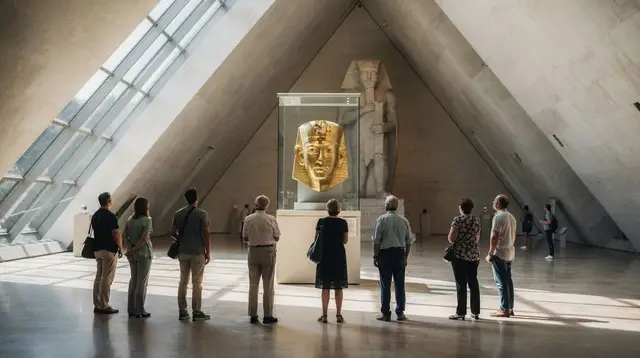
The Bibliotheca Alexandrina opened in 2002 on Alexandria’s eastern harbour, close to where the ancient Library of Alexandria is believed to have stood. It is not a reconstruction and it holds none of the original library’s contents, which were lost in antiquity. What exists now is a modern library and cultural institution: a vast circular reading room built into a tilted disc of a building, several specialised museums inside, a planetarium, exhibition halls, and a research centre. If you are looking for ancient ruins, Kom el Shoqafa and Pompey’s Pillar cover that side of the city separately. This page is about the modern building and how to fit a visit to it into a day trip from Cairo.
The distinction matters because visitors sometimes arrive expecting scrolls, papyri, or physical remnants of the ancient library. There is a small exhibit on the history and legend of the original library, but the building’s real draw is architectural and cultural: the scale of the reading room, the manuscript museum, the antiquities museum inside the complex, and a rotating programme of exhibitions and events. Alexandria’s Al Nasr campus and its cultural calendar make it one of the more active museum-and-culture stops on the north coast, distinct from the day trips built around El Alamein’s beaches further west.
Getting there from Cairo or Giza
There is no way around the travel time. From central Cairo or from a hotel in Giza, the drive to Alexandria runs about three hours along the desert road, and that figure assumes reasonable traffic. Leaving during the Cairo morning rush, or returning through it in the evening, adds time on both ends. This is a full-day excursion, not a half-day add-on, and it should be planned that way from the start.
Most visitors go by private driver, by organised day tour, or by train. The train is comfortable and often faster door to door than driving once you account for Cairo’s traffic on both ends of a car journey; see the Cairo to Alexandria by train guide for the practical details. Whichever way you go, leave Cairo early. A day trip that starts at nine in the morning leaves a noticeably shorter window in Alexandria than one that starts at seven, and the round-trip drive alone eats up roughly six hours of the day.
Departure time also shapes what the library itself feels like on arrival. Groups leaving Cairo before sunrise tend to reach the Bibliotheca Alexandrina as it opens, when the plaza and reading room are at their calmest and before coach tours from Alexandria’s own hotels fill the lobby. Arriving mid-morning is still workable, but expect more visitors moving through the reading room at the same time as you, and a longer wait at the security checkpoint that every visitor passes through at the entrance. None of this changes the sightseeing itself, but it does change how unhurried the first hour feels.
a private guided tour built around the attraction you choose, which works well for an Alexandria day trip from CairoPairing the library with Qaitbay
The single most common mistake is treating the Bibliotheca Alexandrina as a standalone destination. Given the length of the drive from Cairo, it makes far more sense as one half of a two-stop day, paired with the Citadel of Qaitbay, built on the site of the ancient Pharos lighthouse at the harbour mouth. The two sites sit along the same waterfront corridor, so the local transfer between them is short compared to the three hours it took to get to Alexandria in the first place.
A practical order for the day: arrive at the library first, since it tends to be calmer earlier in the day and rewards unhurried time in the reading room and museums; then move along the corniche to Qaitbay for the fortress and the harbour views. Some visitors reverse the order depending on their arrival time and on whether they also want to fit in the nearby catacombs or Pompey’s Pillar, which sit further from the coastal strip and add real driving time within the city itself. If your day is genuinely short, choose between the modern library and the ancient sites rather than trying to do all of it; Alexandria rewards more time than most Cairo-based day trips allow.
If you only have half a day left in Alexandria once the library visit runs long, the honest choice is between Qaitbay and the catacombs, not both. Qaitbay sits on the same waterfront and adds comparatively little driving; the catacombs and Pompey’s Pillar sit inland and cost real time getting to and from the coastal corridor. Visitors who try to fit all three into an afternoon usually end up rushing at least one stop, which defeats the point of having travelled three hours to get there.
a guided tour to an attraction of your choice, useful for building a Bibliotheca Alexandrina plus Qaitbay day around your own prioritiesInside the library: what to actually see
The main reading room is the reason most people come. It is one continuous space built on a slope, lit by a grid of skylights in the roof, and it is large enough that visitors typically spend a good portion of their time simply moving through it rather than reading in the conventional sense. Photography of the room itself is generally permitted, but check current rules on arrival since policies at Egyptian cultural sites change without much notice.
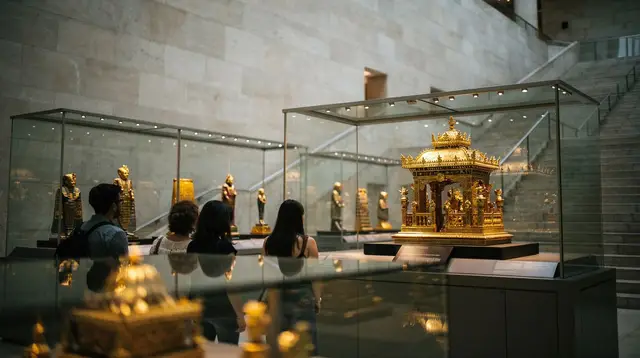
Beyond the reading room, the complex houses several smaller museums: an antiquities museum with objects recovered from Alexandria’s harbour and city, a manuscripts museum, and a museum devoted to the history of writing and the book. There is also a planetarium with its own separate programme and, periodically, temporary exhibitions on subjects ranging from science to contemporary art. None of this requires advance specialist knowledge, but visitors who want to see more than the reading room should budget extra time, since the museums are spread across different levels of the building.
Photography rules are not uniform across the complex, and this catches some visitors off guard. Where the main reading room is generally relaxed about phone photography, the smaller museums inside, particularly the antiquities and manuscripts collections, more often restrict cameras or flash to protect the objects on display. Treat any museum-specific signage as the rule for that room rather than assuming the reading room’s looser policy carries through the whole building.
a guided tour to a museum of your choice, which can cover the library’s own museums or be swapped for another Cairo museum on a different dayBest time of year for this day trip
Because the drive crosses open desert road for most of its length, the comfort of the journey depends heavily on season, and this is easy to overlook when the destination itself is an air-conditioned library. October through April is the easiest window: daytime temperatures on the coast stay mild, and the desert crossing itself is manageable even at midday. June through August bring a different equation. Alexandria’s coastal position keeps it cooler than Cairo, but the desert road in between does not benefit from that, and a midday departure in summer means several hours of genuine heat before the coast brings any relief; an early start matters more in these months than at any other time of year.
Between March and May, the khamsin brings sandstorms that can reduce visibility on the desert road and, on a bad day, are reason enough to postpone the trip rather than push through. This is not a frequent occurrence, but it is worth checking conditions the morning of travel during those months rather than assuming the road will be clear. Friday, the weekly day of rest across Egypt, can also mean different opening patterns at the library and at Qaitbay, and both venues adjust their hours during Ramadan; confirm the current schedule for your travel dates rather than relying on a generic calendar.
How much time to set aside
There is no fixed opening schedule worth quoting here, since hours shift with the season and with Friday closures and Ramadan adjustments across Egypt; check the current schedule before you travel rather than relying on a number printed elsewhere. As a rough planning figure, one to two hours covers the reading room and a walk through one or two of the smaller museums. Visitors with a strong interest in a specific museum, or who arrive during a temporary exhibition they want to see properly, should allow closer to three hours.
Combined with roughly three hours each way on the road and another hour or two at Qaitbay, a Bibliotheca Alexandrina day trip from Cairo runs long: expect to leave before sunrise and return well into the evening. This is worth saying plainly, because Alexandria day trips are sometimes marketed as light, easy outings. The library and the citadel are both manageable in a day, but only if the travel time is respected rather than minimised.
| Segment | Rough time |
|---|---|
| Cairo/Giza to Alexandria (desert road) | About 3 hours |
| Bibliotheca Alexandrina visit | 1–2 hours, more for museums |
| Local transfer to Qaitbay | Short, along the corniche |
| Citadel of Qaitbay visit | 1–1.5 hours |
| Alexandria to Cairo/Giza return | About 3 hours |
Treat these as planning ranges, not promises. Traffic on the desert road and within Cairo on either end can add significantly to the driving legs.
What tends to surprise or disappoint visitors
A handful of things catch first-time visitors off guard. The famous granite-clad exterior, engraved with characters from dozens of world alphabets, reads best from a distance or from photographs taken earlier in the day, since the reflective plaza in front of it can be uncomfortably bright and exposed at midday, with little shade while queuing for security. Inside, some visitors expecting a museum-style experience are surprised that much of the building is, quite literally, a working library, with students and researchers using the reading room alongside tourists; it is not staged for visitors the way a dedicated museum would be, which some find atmospheric and others find underwhelming.
The gift shop and café areas are modest compared to what a site of this profile might suggest, and visitors hoping for an extensive retail or dining experience on site should not build that expectation into the day. It is also worth being honest that, for visitors whose main interest is ancient Egypt rather than modern architecture or libraries, the Bibliotheca Alexandrina can feel like a detour from the day’s real subject; pairing it with Qaitbay softens this, but it will not turn the visit into an ancient-history experience.
Accessibility on site
The complex was built as a modern public building, and the main circulation through the reading room uses ramps and lifts rather than relying solely on stairs, which makes the core visit workable for most visitors with mobility limitations. The approach plaza, however, is finished in granite paving that can be uneven in places, and the distance from a drop-off point to the entrance security check is not negligible on a hot day. Wheelchair users and anyone with limited mobility should confirm current arrangements with a tour operator or directly with the library before travelling, since specific provisions can change and a private driver is generally easier to coordinate around individual needs than a fixed-departure group tour.
Practical notes for the day
Bring cash in Egyptian pounds for small purchases, since Egypt’s currency is the EGP and cards are not universally accepted outside hotels and larger venues. Bottled water is the safer choice throughout the day; tap water is not something to rely on while travelling. Dress is generally relaxed inside the library, though modest clothing is sensible across Egyptian public buildings and museums. If your trip falls in the hotter months, June through August, an early start also means a cooler visit at both the library and the citadel before the midday heat sets in.
If you are combining Alexandria with other parts of your Cairo trip, it helps to know how this excursion compares to the destination as a whole; the day trips from Alexandria overview and the shore excursion options cover the broader set of choices, while the things to do in Alexandria hub lists activities by category. For a longer stay rather than a single day, the four-day Cairo and Alexandria itinerary spreads the city’s sites across more manageable blocks of time.
a two-day highlights guided tour, one way to combine Cairo’s own sights with an Alexandria day trip on a longer stayIs the day trip worth it
For visitors with a genuine interest in libraries, modern architecture, or Egypt’s contemporary cultural institutions, yes, provided the day is planned around both the library and Qaitbay rather than the library alone. For visitors whose main interest is ancient Egypt, the return on a six-hour round trip is smaller unless it is combined with the catacombs and Pompey’s Pillar as well, which pushes the day even longer and is worth weighing against staying closer to Cairo or Giza instead. There is no wrong answer here, only a clearer one once the actual time cost is on the table rather than glossed over.
Bibliotheca Alexandrina: questions before you go
Do I need to book the Bibliotheca Alexandrina in advance?
Booking policies change, so check current arrangements close to your travel date rather than assuming walk-in access. A guided day tour from Cairo typically handles entry as part of the package.
Is the Bibliotheca Alexandrina suitable for a rushed half-day stop?
Not really. Given the three-hour drive each way, a half-day stop leaves very little time at the site itself once travel is subtracted. Treat this as a full-day plan.
What is inside the library besides the reading room?
An antiquities museum, a manuscripts museum, a museum of writing and the book, a planetarium, and rotating exhibition halls, spread across several levels of the building.
How does this differ from a trip to the catacombs and Pompey’s Pillar?
Those sites cover Alexandria’s ancient and Roman-era remains, a separate part of the city with its own travel logic; see the catacombs and Pompey’s Pillar guide for that side of a visit, and read about why the ancient library is gone for background on what came before the current building.
Should I take the train or drive from Cairo?
Both work. Compare the trade-offs in the Cairo to Alexandria by train guide: the train avoids Cairo traffic on both ends, while a private driver gives door-to-door flexibility for a two-stop day.
Is a day trip to Alexandria from Cairo actually worth the time?
Opinions differ depending on what you are after; see the broader discussion in is Alexandria worth a day trip for a fuller comparison against an overnight stay.
Is the Bibliotheca Alexandrina accessible for visitors with mobility needs?
The building itself is modern and largely step-free, with ramps onto the main plaza and lift access between the reading room’s levels, but the granite-clad approach can be uneven underfoot. Confirm current accessibility arrangements with your tour operator before booking.
Is there a best season for a Bibliotheca Alexandrina day trip?
October to April is the most comfortable window, with milder coastal temperatures than the desert road crossing suggests. Summer visits are workable if you start at dawn and treat the middle of the day indoors; a khamsin sandstorm between March and May can occasionally disrupt the desert road itself.
Alexandria and North Coast tours on GetYourGuide
Verified deep-linked GetYourGuide tours. Book through these links and we earn a small commission at no cost to you.
GetYourGuide does not provide a product photo for this activity — the image shows the meeting point, photographed by us.