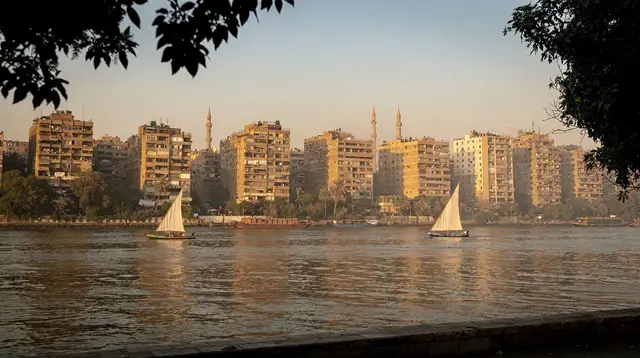
Cairo and Alexandria in four days
This plan keeps Cairo and Giza as a fixed base and treats Alexandria as one deliberate long day, not a quick detour. No rental car is needed: a private driver, Uber, or Careem covers everything, and the Alexandria leg is booked as a single round trip rather than pieced together.
Why base in Cairo and Giza for all four nights
Changing hotels costs time in a city where traffic is dense most of the day. Staying put in Cairo, Zamalek, Garden City, or a Giza hotel facing the plateau means every day starts and ends without repacking. It also means the Alexandria trip can leave early and return late without the extra step of checking into a coastal hotel. Travellers who want where to stay in Cairo guidance should sort that before the pyramid days, since a Giza base cuts the airport-to-pyramids drive down to a short local hop instead of a 60-90 minute crossing.
Day 1: Arrival and the Giza plateau
Most flights land at Cairo International Airport (CAI) in Heliopolis, and the drive to a Giza hotel runs 60-90 minutes depending on traffic. Keep the first afternoon light: settle in, and if there’s daylight left, watch the plateau from a rooftop rather than rushing straight to the sites tired from a flight.
Sphinx International Airport (SPX), west of Giza, handles a much smaller number of flights than CAI, but it sits closer to a Giza hotel. It’s worth a quick check when booking flights, since routing through SPX can turn the first-day transfer into a short local hop rather than a 60-90 minute crossing — though for most travellers, CAI will still be the only realistic option given its wider route network.
In the evening, the sound and light show at the pyramids is a low-effort way to see the Great Sphinx illuminated without the midday heat or crowds.
A private airport transfer to a Giza hotel avoids negotiating a taxi fare after a long flight.
Day 2: Pyramids and the Grand Egyptian Museum
This is the plateau day. See the pyramids of Khufu, Khafre, and Menkaure up close, along with the Great Sphinx, then move to the Grand Egyptian Museum (GEM) next door. The GEM officially opened on 1 November 2025 and now holds the complete Tutankhamun collection, so pairing it with the plateau in one day is realistic since the two sites sit side by side.
Go early. The site opens at its coolest and least crowded, and a private driver waiting between stops removes the friction of finding transport at the gate.
One thing worth knowing before arriving: touts and unofficial guides work the approach to the plateau, offering camel rides, “free” entry tips, or photo assistance that turns into a payment demand afterward. A private driver or a booked tour reduces this friction, since a guide handles most of the interactions a traveller would otherwise face alone at the gate. It doesn’t ruin the visit, but arriving with the expectation set makes it far easier to decline politely without feeling caught off guard by the first approach.
| Stop | Typical time needed |
|---|---|
| Giza plateau (pyramids + Sphinx) | Half day |
| Grand Egyptian Museum | Half day |
| Saqqara add-on | Not this day — separate trip |
A guided group tour of the pyramids and Sphinx is a straightforward way to cover the plateau with an egyptologist explaining the layout, and a private tour through the Grand Egyptian Museum makes sense for the afternoon since the collection is large enough that a guide’s pacing helps.
For travellers who’d rather see the pyramids without the museum crowd add-on, a private half-day pyramids tour covers just the plateau.
Day 3: Cairo — Islamic or Coptic, depending on the weather
Day three stays in the city and skips a long transfer. Choose between Islamic Cairo and Coptic Cairo based on heat and how the previous two days went — both are walkable but Islamic Cairo covers more ground.
Islamic Cairo: the Citadel of Saladin and the Mosque of Muhammad Ali, Al-Azhar mosque (founded in 970), the Khan el-Khalili bazaar, and a walk down Al-Muizz Street past the Sultan Hassan mosque.
Coptic Cairo: the Hanging Church and Ben Ezra Synagogue, the Coptic Museum, and nearby Fustat, home to the National Museum of Egyptian Civilization (NMEC) — where the royal mummies have been displayed since the April 2021 Pharaohs’ Golden Parade, not at the Egyptian Museum on Tahrir Square.
Dress modestly for mosques and churches: cover shoulders and knees, women cover their hair inside mosques, and shoes come off at the door.
If there’s time before or after, the older Egyptian Museum on Tahrir Square is still open and worth a stop — it hasn’t closed since the GEM opened, and its collection is different, not a duplicate. A private guided tour of the Egyptian Museum is a practical way to fit it into an otherwise packed Cairo day.
End the day differently if preferred: a felucca sail on the Nile at sunset is a quieter alternative to another museum stop.
Day 4: Alexandria — a long day, not a detour
This is the trip’s one big excursion outside the capital, and it needs to be treated as a full day, not squeezed in. Alexandria is about three hours from Cairo by the desert road, each way — six hours of driving before sightseeing time is counted. A private driver makes this manageable: leave early, ideally before 7am, to get real time on the ground.
The desert road itself has limited services compared with city driving — a scattering of rest stops, but nothing to count on for a proper meal. Packing water and snacks for the car is worth doing rather than assuming a stop will appear when needed. Traffic near both Cairo and Alexandria can also add to the three-hour estimate on either end, so a driver who knows current road conditions is worth more on this leg than on the shorter, purely local days.
Once there, three stops anchor the day: the Bibliotheca Alexandrina (opened in 2002, a modern landmark rather than an ancient one), the Citadel of Qaitbay built on the site of the ancient Lighthouse of Alexandria, and the catacombs of Kom el Shoqafa along with the nearby Pompey’s Pillar. That’s a realistic day’s worth of sightseeing once the drive is factored in — trying to also reach El Alamein or Wadi Natrun the same day turns a long day into an exhausting one.
Alternatives to a private driver exist: a train from Cairo to Alexandria runs alongside the road option, and travellers deciding between the two should compare timing and comfort before booking either way. Those who’d rather not drive at all can look at Alexandria day trips from Cairo run as an organised outing.
Return to Cairo or Giza the same night — don’t plan anything for the evening after this day; the round-trip drive alone is six hours.
What this itinerary leaves out
This plan deliberately skips the White Desert and Fayoum, which need their own multi-day trip, the Red Sea coast, and Luxor and Aswan, which are reached by internal flight or overnight train and don’t fit inside four days built around a Cairo base. Travellers wanting those regions should look at a longer itinerary instead.
Practical notes for this trip
Egypt’s currency is the Egyptian pound (EGP, written LE or E£) — not the dollar or the euro, even though some tour listings show prices in foreign currency for reference. Carry cash for small purchases and baksheesh (tipping is customary and expected for small services); cards work in hotels, malls, and most restaurants. Entry for most visitors from the EU, UK, US, and Canada requires a visa — either an e-Visa through the official visa2egypt.gov.eg portal or a visa on arrival at the airport for eligible nationalities; check the official site for current fees rather than relying on a fixed number. Tap water isn’t safe to drink — stick to bottled water throughout the trip. Friday is the weekly rest day, and opening hours shift during Ramadan, so it’s worth checking ahead if the trip lands during either.
Egypt runs on UTC+2, with daylight saving (UTC+3) reinstated since 2023 — worth checking the exact clock-change dates if the trip falls near one, since it affects how sunset lines up with the evening sound and light show. Power sockets are the European two-pin type, 220V, types C and F, so a plug adapter matters for travellers from the UK, US, or elsewhere without that standard. Arabic is the local language, but English is widely used around tourist sites, hotels, and with drivers, which keeps day-to-day logistics manageable without needing more than a few basic phrases.
FAQ: planning four days between Cairo and Alexandria
Is Alexandria doable as a day trip from Cairo, or should we stay overnight?
Both work, but this itinerary treats it as a long day trip with a private driver, about three hours each way. An overnight stay gives more breathing room if the schedule feels rushed, but it also means repacking and losing a Cairo-based evening.
How many pyramids are there at Giza, and can we see them all in one day?
Three main pyramids: Khufu, Khafre, and Menkaure, plus the Great Sphinx nearby. Combined with the Grand Egyptian Museum next door, a full day covers both comfortably; adding Saqqara the same day is not realistic given the driving and site time involved.
Do we need a rental car for this itinerary?
No. A private driver or Uber/Careem covers local moves around Cairo and Giza, and the Alexandria round trip is best booked as a single private-driver day rather than self-driving through Cairo traffic.
Where are the royal mummies — the Egyptian Museum or somewhere else?
The royal mummies moved to the National Museum of Egyptian Civilization (NMEC) in Fustat in April 2021. The Egyptian Museum on Tahrir Square is still open and holds a large separate collection.
Has the Grand Egyptian Museum fully opened?
Yes. It was officially inaugurated on 1 November 2025 and holds the complete Tutankhamun collection, next to the Giza plateau.
What’s the best time of year for this itinerary?
October through April is the most comfortable window, with cooler evenings and mornings. June through August often passes 35°C, so sites should be visited at opening time if travelling then. Sandstorms (khamsin) are possible from March to May.
Should we choose Islamic Cairo or Coptic Cairo for day three?
Islamic Cairo covers more ground — the Citadel, Al-Azhar, Khan el-Khalili, and Al-Muizz Street — and suits a full day of walking. Coptic Cairo is more compact and pairs naturally with a stop at the NMEC in nearby Fustat.
Can we fit El Alamein or Wadi Natrun into the Alexandria day?
Not comfortably. With six hours of driving to and from Alexandria already, adding another stop turns a long day into an overly rushed one. Both are better left to a dedicated coastal itinerary.
Is Sphinx International Airport (SPX) worth choosing over Cairo International (CAI)?
SPX, west of Giza, has far fewer routes than Cairo International Airport (CAI) in Heliopolis, so most travellers won’t have the option either way. If a flight does route through SPX, it can mean a shorter transfer to a Giza hotel — worth checking, but not worth restructuring a trip around.
What if the desert road to Alexandria is busier than expected?
Traffic near Cairo and near Alexandria itself can add extra time beyond the open-road three-hour estimate, especially leaving during the morning rush. Building in a buffer before any timed reservation, like a guided catacombs visit, avoids a scramble caused by a slower-than-expected drive.
tours.4 days
Verified deep-linked GetYourGuide tours. Book through these links and we earn a small commission at no cost to you.
GetYourGuide does not provide a product photo for this activity — the image shows the meeting point, photographed by us.