A more comfortable way to see Cairo and Giza
What actually makes a Cairo and Giza trip more comfortable?
A private driver for every day trip removes the guesswork from Cairo's dense traffic and the 45-90 minute run between downtown and the Giza plateau. A Giza hotel with pyramid views saves that commute entirely and pairs well with an unhurried Grand Egyptian Museum visit. Cards cover hotels and malls, but cash in Egyptian pounds is still needed for baksheesh.
What a higher budget actually buys in Cairo
Most Cairo planning advice focuses on stretching money: which sites to skip, which tour to book instead of another, where to save on transport. This page takes the opposite question. If cost is not the constraint, where does the extra money actually go, and does it change the trip in a way that matters?
The honest answer is narrower than most luxury guides suggest. Cairo and Giza do not have a five-star version of every experience — the pyramids are the same pyramids for every visitor, and the Grand Egyptian Museum charges the entrance it charges regardless of hotel category. What money buys here is mostly service and time: fewer hours lost to traffic, a shorter or nonexistent commute to the plateau, a slower pace inside the museums, and someone else managing the logistics of a day trip. None of that shows up as a bigger monument. It shows up as fewer bad hours.
A private driver as the standard, not the upgrade
For a single visitor or a couple on a tight schedule, a shared group tour or a taxi booked stop by stop is a reasonable way to see Cairo. Once comfort matters more than saving on transport, a private driver for every day trip should be treated as the baseline, not an optional extra.
The reason is Cairo’s traffic, not the distances themselves. The run between downtown Cairo and the Giza plateau covers roughly 45 to 90 minutes depending on the time of day, and that range is wide because the city’s traffic is dense for most of daylight hours, not because the distance itself varies. A shared vehicle waits for other passengers, sticks to a fixed schedule, and cannot adjust when a site takes longer than planned or when traffic on a particular route is worse than usual. A private driver absorbs all of that. You leave when you are ready, you linger at the Great Sphinx or inside the Egyptian Museum (Tahrir) for as long as you want, and the driver adjusts the route rather than the schedule adjusting you.
This matters even more once a day includes more than one stop. A morning at Saqqara followed by Dahshur and Memphis, or a Giza plateau visit followed by lunch in Zamalek, works far better with a driver who is waiting exactly where you left them than with any shared transport model. See hiring a private driver in Cairo for how that arrangement typically works, and Cairo traffic and realistic travel times for what to expect hour by hour.
a private guided visit to the attraction of your choice, with a driver and guide for the day is the closest match to this approach: you pick the site, the pace is yours, and the vehicle is not shared with other travellers.
Airport pickup follows the same logic. Cairo airport transfers and the Cairo airport arrival guide cover the 60-to-90-minute run from Cairo International Airport (CAI) in Heliopolis to Giza — a stretch where a pre-arranged driver waiting at arrivals removes the one part of a long-haul arrival that tends to go wrong.
Where you sleep changes what your day looks like
Cairo’s accommodation choice usually comes down to two very different bases: the city centre — downtown, Zamalek, Garden City, Heliopolis — or a hotel on the Giza side, facing or near the plateau. Both are legitimate, and neither is objectively better; they suit different priorities. See where to stay in Cairo for the full comparison.
A city-centre hotel puts you closer to Islamic Cairo, Coptic Cairo, the Nile corniche, and Cairo’s restaurants and evening life. A Giza hotel with a pyramid view removes the commute to the plateau altogether — no 45-to-90-minute drive each morning, no traffic to plan around before an early visit. For a traveller whose main goal is the Giza Pyramids and the Grand Egyptian Museum, waking up already at Giza is the single change that does the most for the day, more than any single tour booking. It also means an evening at the Giza sound and light show is a short walk or a five-minute drive rather than a return trip across the city after dark.
The trade-off is real: a Giza-based stay puts you further from Islamic Cairo’s mosques and Khan el-Khalili, and further from most of the city’s dinner and nightlife options, which cluster around Zamalek and downtown. Some travellers split a longer stay between both — a few nights in the centre for the city sights, a few nights in Giza for the plateau and the museum — rather than choosing one base for the whole trip.
Pairing the Grand Egyptian Museum with the plateau, unhurried
The Grand Egyptian Museum (GEM), officially inaugurated on 1 November 2025 and standing beside the Giza plateau, holds the complete Tutankhamun collection and is large enough that a rushed visit undersells it. A same-day pairing with the pyramids and the Great Sphinx is realistic — the two sites sit next to each other — but trying to add Saqqara or Dahshur to that same day is the kind of itinerary that only works on paper.
The comfortable version of this day gives the plateau a full morning — Khufu’s pyramid, Khafre’s, Menkaure’s, and the Great Sphinx, ideally starting near opening before the heat and the crowds build — and then moves to the GEM for the afternoon without a fixed end time. A private guide inside the museum, rather than a fixed-departure group tour, means you can spend real time with the Tutankhamun galleries and skip past sections that interest you less, instead of following someone else’s clock. See the Grand Egyptian Museum guide and, for how it compares to the older Tahrir museum, Grand Egyptian Museum vs Egyptian Museum (Tahrir) — both museums are open and worth different amounts of time, and neither has replaced the other.
a private guided tour of the Egyptian Museum and a guided tour of the museum of your choice both work as a way to set your own pace rather than joining a scheduled group slot, which matters more here than at almost any other site in Cairo given how much each museum holds. For solo women travelling without a mixed group, a female-led option is also available for the Egyptian Museum specifically.
A private Egyptologist guide is worth considering beyond the museums too — at hiring an Egyptologist guide in Cairo, the difference is less about access and more about depth: a good guide explains what you are looking at rather than reciting a script, and can adjust the order of a visit around your questions.
An evening on the Nile, without the standard dinner-cruise crowd
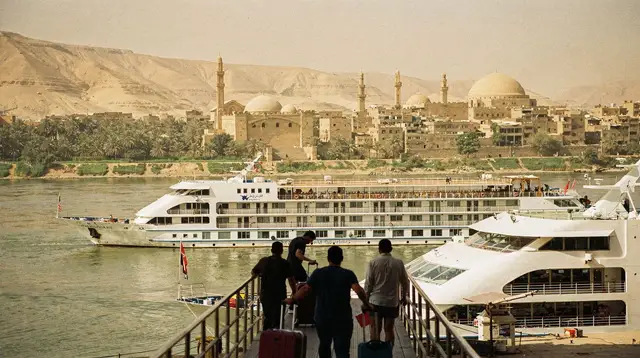
Cairo’s felucca sails and dinner cruises are popular for a reason — the Nile at sunset is genuinely worth the time — but the standard version can mean a large boat, a set menu and a fixed show. A higher-comfort version of the same evening exists: smaller vessels, a more considered menu, and a slower pace. See Nile felucca and dinner cruises in Cairo for how the options differ.
a Nile dinner cruise with a belly dance show aboard a higher-end boat is worth booking ahead rather than arranging at the dock, since the better boats and the earlier, less crowded sailing times fill first.
Cards cover hotels; cash still covers baksheesh
One detail a bigger budget does not erase: Egypt runs on cash for a meaningful share of daily transactions, and no amount of spending changes that. Hotels, malls and most restaurants in Cairo accept cards without issue, and that holds regardless of the hotel’s star rating. But the currency in use is the Egyptian pound (EGP, written LE or E£) — not the US dollar or the euro, even though some tour listings display prices in a foreign currency for reference — and small cash amounts in EGP are still needed for baksheesh, the tipping culture that runs through almost every service interaction in Egypt: drivers, porters, guides, restroom attendants, and staff at sites who point out a good photo angle or open a locked area.
This is not a budget-traveller problem that disappears with more money. A traveller staying in the best hotel in Giza still needs cash in hand for the driver at the end of each day, for the guide, and for the small tips that come up constantly during a day of sightseeing. Carrying a stock of low-denomination notes across the trip matters more than carrying a large amount once. See baksheesh and tipping in Egypt for how this actually plays out day to day, and money, cards and ATMs in Cairo for where to change or withdraw cash without relying on hotel exchange desks, which tend to offer a weaker rate.
A day out beyond the plateau, still with a driver
Not every higher-comfort day needs to stay inside Cairo and Giza. Day trips further out — Saqqara, Dahshur and Memphis together, or a full day at the Africa Safari Park — work the same way: a private vehicle removes the scheduling constraints of a group departure and lets the day run at whatever pace the group actually wants.
a guided day trip to Africa Safari Park with lunch included is one example of a day trip that benefits from private transport simply because of the distance and the return time involved. A private guided tour of an attraction of your choice works the same way for the plateau itself, or for Saqqara, Memphis and Dahshur as a combined half-day or full day.
What does not change with a bigger budget
It is worth being direct about the limits of this. The road time to Alexandria stays around three hours; the road time to Ain Sokhna stays around two hours; a comfortable private car does not compress either. The Grand Egyptian Museum and the Egyptian Museum charge the entrance they charge. Louxor and Assouan are still reached from Cairo by internal flight or overnight sleeper train, not by any day-trip arrangement, however well resourced. A higher budget changes the quality of the hours you spend, not the number of hours a genuinely long trip takes.
It is also worth resisting the instinct to overfill a comfortable day simply because a private driver makes it logistically possible. Saqqara, Dahshur and Memphis together in one morning works. Adding the Giza plateau to that same day does not — not because the driver cannot manage it, but because three or four major sites in one day leaves too little time at any of them to be worth the visit.
Cairo and Giza comfort, at a glance
| What changes | Standard approach | Higher-comfort approach |
|---|---|---|
| Day-trip transport | Shared group tour, fixed schedule | Private driver, flexible pace |
| Base for the plateau | Downtown or Zamalek, 45-90 min commute | Giza hotel facing the pyramids, no commute |
| Museum visits | Fixed-time group slot | Private guide, self-set pace |
| GEM + plateau in one day | Rushed, often skipped together | Realistic when staying in Giza |
| Evening on the Nile | Large boat, set menu | Smaller boat, slower pace |
| Payment | Cards where accepted | Cards for hotels; cash still needed for baksheesh |
Frequently asked questions about a more comfortable Cairo trip
Is a private driver worth it for every day trip from Cairo?
For anyone not on a tight budget, yes. Cairo traffic is dense for most of the day, and a driver who knows the current state of the roads, waits at each stop, and handles parking removes a genuine source of friction that a self-drive or public-transport day trip does not.
Should I stay in Giza or downtown Cairo?
Downtown, Zamalek, Garden City and Heliopolis put you closer to Islamic Cairo, Coptic Cairo and the city’s restaurants and nightlife. A Giza hotel facing the plateau removes the 45-90 minute commute to the pyramids entirely and is worth the trade-off if the Giza plateau and the Grand Egyptian Museum are the priority.
Can I combine the Grand Egyptian Museum with the Giza plateau in one day?
Yes, and comfortably so if you are staying in Giza and not rushing to fit in Saqqara the same day. Pairing the plateau with the museum works better as two unhurried halves of one day than as an add-on to a longer itinerary.
Do hotels and restaurants in Cairo accept cards?
Most hotels, malls and a good share of restaurants take cards without issue. Smaller shops, drivers, guides and anywhere baksheesh applies still expect cash in Egyptian pounds.
How much cash should I carry for baksheesh?
Egypt’s tipping culture runs on small, frequent cash amounts rather than one lump sum, so carrying a stock of low-denomination Egyptian pounds across a trip matters more than the total amount. Cards do not substitute for this.
Is it worth hiring a private guide inside the museums?
A private guide changes the pace of a museum visit from a scheduled walk-through to something you can slow down or skip through as you like, which matters most at the Grand Egyptian Museum and the Egyptian Museum given how much each holds.
Does a higher budget change how long the Alexandria or Saqqara day trips take?
No. The road time to Alexandria (around three hours) or Ain Sokhna (around two hours) does not shorten with a private car, but the trip feels shorter because you are not managing directions, stops or a group’s pace.
Budget-friendly Cairo and Giza tours on GetYourGuide
Verified deep-linked GetYourGuide tours. Book through these links and we earn a small commission at no cost to you.
GetYourGuide does not provide a product photo for this activity — the image shows the meeting point, photographed by us.