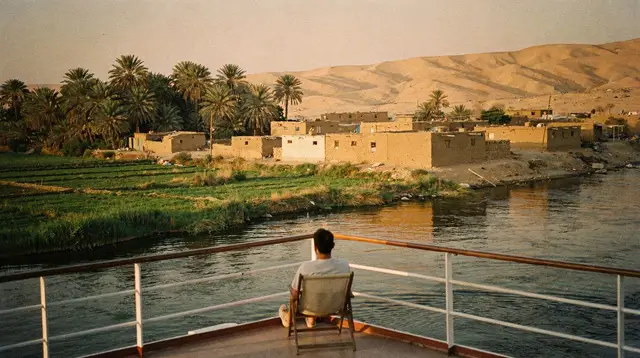
Nile cruises between Luxor and Aswan
How does a Nile cruise between Luxor and Aswan actually work from Cairo?
You fly around an hour from Cairo to Luxor, or take an overnight sleeper train, then board a boat that spends several days moving between Luxor and Aswan with stops at temple sites along the way. It is sold as a multi-day package from Cairo, not a day trip, and Abu Simbel is usually added as a separate excursion once you reach Aswan.
Getting to the boat: flight or sleeper train
A Nile cruise between Luxor and Aswan is not something you reach from a Cairo hotel in an afternoon. It starts with a proper transfer south, and there are two practical ways to make it. The first is a domestic flight from Cairo to Luxor, which takes around an hour in the air and is the fastest way to reach the boat with a full day still ahead of you. The second is the overnight sleeper train from Cairo, which covers the distance while you sleep and puts you in Luxor in the morning, at the cost of a night that is not spent lying flat in a proper bed. Both options are covered in more detail on our flight versus sleeper train comparison, which is worth reading before you commit to one over the other.
Most packages that include a cruise are sold as a single booking from Cairo: transport down, days on the boat, and often the return leg as well. That matters because it changes how you should think about pricing and scheduling. You are not booking a boat and a flight separately and hoping the timings line up; you are booking a package, and the fine print of what is and is not included is what actually decides whether the trip runs smoothly. For a broader sense of how these Cairo-based packages are structured, see our Luxor trips from Cairo guide, and for the wider category of multi-day options leaving the capital, Egypt multi-day tours from Cairo.
Why this is not a day trip, and why that is the point
Everything else in this guide network that leaves Cairo for a few hours — Giza, Saqqara, even Alexandria at three hours each way — is built around the idea of sleeping back in Cairo or Giza that night. A Nile cruise breaks that pattern entirely. Once you board in Luxor, or in Aswan if the cruise runs the other direction, you are committed to several nights on the water before you disembark. There is no version of this that folds into a day trip from Cairo, and any listing that implies otherwise is describing something else, most likely a single-day excursion to Luxor rather than a cruise.
That slower rhythm is the actual selling point, not a drawback to work around. A cruise means you unpack once, and the boat itself handles the movement between Luxor’s east and west bank sites and the temples further south, rather than you managing a series of separate transfers and hotel changes. If you are trying to decide whether that trade-off suits your trip, our Nile cruise versus Luxor hotel stay comparison lays out both approaches side by side.
a three-night cruise sailing between Aswan and Luxor is the shorter end of what is on offer, and it gives a reasonable sense of the format without committing a full week to it. Longer packages exist for travellers who want more time at each stop rather than a tighter schedule.
Choosing when to sail
Timing matters more on a Nile cruise than it does for most of what is covered elsewhere on this site, because you are on the water and on open decks for most of each day rather than moving between a car and an air-conditioned site. October through April is the comfortable window: mornings on deck are cool enough to enjoy, and the daytime temperature during temple stops rarely becomes the limiting factor. Winter days in Upper Egypt run milder than the desert heat further north, though nights on the river can still feel cold enough to want a layer after sunset.
June through August is a different trip. Daytime temperatures regularly climb past 35 degrees Celsius, and unlike Cairo, where a driver can retreat to an air-conditioned car between sites, a cruise itinerary keeps you outdoors at Karnak, Philae or Kom Ombo at whatever hour the boat’s schedule has set. Operators generally shift excursions to the earliest possible slot in summer for exactly this reason, so a July departure still works, but it rewards travellers who do not mind an early start more than a winter one does. The khamsin sandstorm season that affects the north of the country from March to May is felt less on this stretch of the Nile, though hazy skies are still possible.
What can disappoint, said plainly
A cruise is sold on its slower pace, and that same pace is what some travellers find frustrating once they are on board. Meal times, excursion departures and even how long the boat lingers at a given mooring are set by the itinerary, not by you, and a temple visit that runs on a tight morning slot can mean sharing the site with several other boats’ worth of visitors who were scheduled at the same hour. Karnak and the Valley of the Kings in particular can feel crowded mid-morning during the October-to-April season, when most boats are moving on similar timetables.
The boats themselves vary more than glossy brochure photos suggest. Older vessels in a fleet can have smaller cabins, thinner walls between rooms, and weaker air conditioning than the newest ones, even when sold under the same operator name and a similar price. None of this makes a cruise a poor choice, but it is worth going in without the expectation of a resort-standard cabin on every departure, and worth checking recent reviews of the specific boat named in a listing rather than the operator’s fleet in general.
What the days on board actually look like
The exact itinerary varies by operator, but the shape is consistent. Days are built around a handful of temple and tomb visits at set points along the river, interspersed with time actually sailing, when there is nothing scheduled beyond watching the riverbanks go by. Meals are on board, and the boat itself is where you sleep each night rather than moving between hotels. This is a genuinely different pace from anything based in Cairo, where the day is usually built around one or two sites and a private driver navigating traffic between them, as described in our Cairo traffic and realistic travel times guide.
Because the schedule is fixed once you board, it is worth being honest about what this format rewards and what it does not. It rewards travellers who want the sites handled for them and who do not mind a slower, less flexible pace. It does not suit anyone who wants to linger an extra hour at one temple and skip another entirely, since the boat’s schedule is shared across everyone on board. If flexibility matters more to you than the convenience of not repacking each day, a private-guide-based stay may fit better than a cruise; our private versus group tours in Cairo guide discusses that trade-off in the Cairo context, and the same logic applies further south.
a four-day cruise to Luxor that adds a hot air balloon flight combines the boat itinerary with the balloon flight that departs from Luxor’s west bank at dawn — worth knowing about since the balloon is a Luxor-specific activity and never something offered above Cairo or Giza. More on that timing in our Luxor hot air balloon from Cairo guide.
Luxor and Aswan: two different halves of the same trip
Luxor and Aswan are around 200 kilometres apart by river, and a cruise is essentially the vehicle that connects them without you having to organise separate transport for each leg. Luxor’s sites sit on both banks: temple complexes and markets on the east bank, and royal tombs and mortuary temples on the west bank, all covered in our things to do in Luxor guide. Aswan, further south, has a different character — quieter, closer to Nubian culture, and the practical base for reaching Abu Simbel — which we cover separately in things to do in Aswan.
The destination pages for Luxor and Aswan give a broader orientation to each city if you are still deciding how much time to allocate where, and the Upper Egypt region page ties the two together with the wider logic of how this part of the country is sold from Cairo, by flight or sleeper train rather than by road.
Abu Simbel: further south, and usually a separate add-on
Abu Simbel is not part of the Nile cruise itself. It sits well south of Aswan, close to the border with Sudan, and reaching it means either a long road convoy or a short flight from Aswan, undertaken as a distinct excursion once the boat has already arrived there. Some cruise packages include an Abu Simbel add-on and some do not, so this is one detail worth checking rather than assuming. Our dedicated Abu Simbel from Cairo guide covers how that extra leg works and what to expect from the early start it usually requires.
a five-day, four-night cruise departing by plane from Cairo is a useful option if you want more time to fit Abu Simbel in without rushing the rest of the itinerary, since the extra day gives the schedule some breathing room around the temple stops.
Cabin category: what is actually worth paying for
Every operator sells the same boat across a range of cabin categories, and the honest advice is that the jump from a standard cabin to a mid-tier one usually buys more useful space than the jump from mid-tier to the top suite category does. A standard cabin on most Nile cruise boats is compact, with a fixed window rather than a balcony and limited space to spread out luggage for several nights. Paying for a deck with a proper balcony or a larger window is the upgrade most travellers notice and appreciate, since a lot of the trip’s actual pleasure is watching the riverbank go by from your own cabin rather than only from the shared sun deck. The suite-level upgrades above that tend to add marginal extras, like a slightly larger bathroom, that matter less once you account for the days spent off the boat at temple sites.
Accessibility on board
Nile cruise boats were not built with modern accessibility standards in mind, and this is one area where the marketing rarely matches the reality. Multiple decks connected only by stairs are standard, cabins on lower decks may have limited natural light, and boarding the boat itself can mean crossing a narrow gangway that shifts with the river’s water level. Temple sites along the route add their own uneven ground, loose stone and steps, often without a paved alternative route. Travellers who need level access, or who are travelling with a wheelchair or limited mobility, should contact the operator about the specific vessel assigned to a given departure before booking, rather than relying on general photos of the fleet, since accessibility can vary considerably between boats operated under the same brand.
If a cruise is not what you want
Not every visitor to Luxor and Aswan wants several nights on a boat. A more compressed alternative is a short trip to Luxor and back without the cruise segment at all, staying in hotels instead and using a private driver or guide for the sites on both banks. That approach trades the cruise’s slower pace and included transport for a tighter schedule and the flexibility to skip or extend any single stop.
an overnight trip to Luxor by plane covers exactly that shorter format, flying down, staying a night or two in a hotel, and flying back, without committing to a multi-day boat schedule. For travellers who would rather take the train than fly either way, a Luxor trip from Cairo by sleeper train follows the same overland route described earlier in this guide, and our sleeper train to Luxor piece has more on what an overnight in a train cabin is actually like.
Whichever format you pick, the planning logic from Cairo is the same: this is a package built around getting south and back, not something that folds into a Cairo-based day out. Our Cairo and Luxor in five days itinerary and the longer one week Cairo, Luxor and Aswan itinerary both show how a Nile cruise segment fits into a wider Egypt trip that starts and ends in Cairo, and the Nile cruises and multi-day category lists the full range of formats if the ones covered here do not match what you are after.
Nile cruise from Luxor to Aswan: questions before you book
Do I need to book the Cairo-Luxor flight separately from the cruise?
Most packages sold from Cairo bundle the flight or the sleeper train together with the cruise itself, so you book one package rather than arranging transport and boat nights separately.
Can I do a Nile cruise as a day trip from Cairo?
No. A cruise runs over several days and nights on the water between Luxor and Aswan, and none of it can be compressed into a same-day return to Cairo.
Is the sleeper train a good alternative to flying?
It removes an airport transfer and a short flight, and puts you in Luxor by morning, but it means a night of train travel rather than a proper hotel or boat bed, so it comes down to preference for overland travel over speed.
Does the cruise go from Luxor to Aswan or the other way around?
Both directions exist. Some boats board in Luxor and sail south, others board in Aswan and sail north, and the temple stops along the route are broadly similar either way.
Is Abu Simbel included in the cruise?
Not automatically. It sits further south of Aswan and is usually a separate excursion, by road or short flight, added once the boat has reached Aswan.
How many days should I set aside for this from Cairo?
Counting the cruise itself plus travel to and from Cairo, a realistic minimum is around four to five days away from the capital.
Is a Nile cruise worth it compared to staying in a Luxor hotel?
A cruise saves you from changing hotels and handles transport between sites, but locks you into a fixed schedule with less flexibility than basing yourself in one city and arranging your own excursions.
Can I fit a Nile cruise in alongside the pyramids and Cairo sightseeing?
Yes, but as separate legs of the same trip rather than a combined day. Most visitors do Cairo and Giza first, then fly or take the train south for the cruise, as shown in the itineraries linked above.
When is the best time of year to take a Nile cruise between Luxor and Aswan?
October to April is the most comfortable window, with cooler mornings on deck and daytime temperatures that make the outdoor temple visits manageable. June to August is workable but hot, often well above 35 degrees Celsius by midday, so the early excursions matter even more than they do in Cairo.
Are Nile cruise boats accessible for travellers with mobility needs?
Not reliably. Most boats have stairs between decks and no lift, gangways onto the riverbank can be steep depending on the water level, and temple sites along the route involve uneven ground and steps, so travellers with mobility needs should ask the operator about a specific boat before booking rather than assuming.
Multi-day Nile cruise tours on GetYourGuide
Verified deep-linked GetYourGuide tours. Book through these links and we earn a small commission at no cost to you.
GetYourGuide does not provide a product photo for this activity — the image shows the meeting point, photographed by us.