Cairo weather by month: when to visit
What is the best time of year to visit Cairo?
October to April is the most comfortable stretch, with winter daytime temperatures around 20°C and cool mornings and nights. June to August is often above 35°C, so plan sites like Giza and Saqqara for opening time. Rain is negligible year-round, and a khamsin sandstorm window can hit March to May.
Reading Cairo’s climate before you book
Cairo sits in a hot desert climate, which makes the calendar simpler than it looks from outside. There is no rainy season to route around, no monsoon, no month where outdoor sightseeing is off the table. The one variable that actually changes your day-to-day comfort is heat, and it moves in one broad arc: cool from November to March, warming through April and May, hot from June to August, and cooling back down through September and October. Everything else on this page — things to do in Cairo, a Giza pyramids morning, an Alexandria day trip — sits on top of that one curve.
This page is the reference for the full year. If you already know your trip falls inside the March–May window and want the detail on sandstorms, see Cairo in spring and the khamsin. If you are weighing a trip around the December holidays specifically, Christmas and New Year in Cairo covers that narrower question. This guide covers the calendar as a whole, so you can pick dates before you get into either of those specifics.
The two seasons that actually matter
Strip away the month names and Cairo really has two seasons worth planning around.
October to April is the comfortable season. Winter days (December, January, February) sit around 20°C, with mornings and nights noticeably cooler — bring a layer for early starts at Giza or an evening felucca on the Nile. Shoulder months (October, November, March, April) run a few degrees warmer during the day but still stay pleasant, and outdoor sightseeing works at almost any hour.
June to August is the heat season. Afternoon temperatures regularly clear 35°C, and the sun at Giza or Saqqara with no shade is a different experience at midday than at 8 a.m. This is the season to build a trip around early starts: visit the Giza pyramids or Saqqara, Memphis, and Dahshur at opening, retreat indoors — the Grand Egyptian Museum is air-conditioned — through the hottest hours, and save felucca time or a Nile dinner cruise for after sunset when the heat breaks.
September and May sit between the two, closer to the warm end but without the full intensity of high summer.
Timezone, daylight, and why an early start actually helps
Cairo runs on UTC+2 for part of the year, with clocks moving to UTC+3 during daylight saving — Egypt reintroduced daylight saving time in 2023 after nearly a decade without it, so it is worth double-checking the current offset rather than assuming the timezone from an older trip or an outdated guidebook. The practical effect on a heat-season visit is straightforward: sunrise in June and July comes early, and an 8 a.m. arrival at the Giza plateau or Saqqara is genuinely two or three hours cooler than a 10 a.m. arrival, not a marginal difference on paper only.
In winter the same early-start logic applies with less urgency, since the whole day tends to stay comfortable from morning through evening, but sunrise is later, so a dawn departure buys less usable daylight than it would in summer. Whichever season a trip falls in, confirming the current UTC offset a day or two before travel is a small check that avoids a missed early pickup with a private driver or a tour group.
Month-by-month at a glance
Daytime highs are approximate ranges for planning, not forecasts — check conditions closer to your travel dates.
| Months | Typical daytime feel | What it means for sightseeing |
|---|---|---|
| December–February | Around 20°C by day, cool mornings and nights | Best all-round comfort; layer up before sunrise |
| March–May | Warming through the 20s toward 30°C+ | Pleasant most days; khamsin sandstorm risk in this window |
| June–August | Often above 35°C by early afternoon | Visit outdoor sites at opening; midday best spent indoors |
| September–November | Cooling from summer heat back toward mild | Comfortable, especially from mid-October |
Rain does not appear as a meaningful column here on purpose — see below.
Rain, or the near-total lack of it
Cairo’s rainfall is close to zero in every month of the year. This is a desert city, and even the wetter winter months bring, at most, an occasional light shower rather than anything that would disrupt a day of sightseeing. Do not pack for rain, and do not build flexibility into an itinerary to work around it — it is not the variable that matters here. Humidity follows the same pattern: low year-round, which is part of why the summer heat, while intense, is a dry heat rather than the heavier feel of a humid climate at the same number.
Water, hydration, and the heat you do not feel coming
Cairo’s tap water is not something to drink straight from the tap, in any season — bottled water is the standard for visitors, and it is worth building into a summer day’s planning rather than treating as an afterthought bought when thirst already sets in. Dry desert heat is deceptive: without the stickiness of a humid climate, it is easy to underestimate how much water a day in the sun at Giza or Saqqara draws out of you, and dehydration often shows up first as fatigue or a headache rather than an obvious thirst signal.
A liter or more of bottled water per person for a half-day outdoor stretch in June through August is a reasonable baseline, more if the itinerary involves walking between sites rather than shuttling between them by private driver. In the cooler months this matters far less — the same half-day might need only a fraction of that — which is one more practical reason the October–April window is easier on a first-time visitor than the summer heat, beyond simple comfort at the surface level.
Winter (roughly December–February): the peak comfort window
This is the season most first-time visitors should aim for if dates are flexible. Daytime temperatures around 20°C make walking tours of Islamic Cairo and Coptic Cairo, long stretches at the Giza plateau, and a full day combining Saqqara, Dahshur, and Memphis genuinely comfortable from morning to evening. The trade-off is that this is also peak season: expect busier sites and hotels booked further ahead. Mornings and nights are the part visitors underestimate — pack a layer for a sunrise start at Giza or an evening on the water, since it drops noticeably once the sun is down. A short, dressed-up evening out works well in this window; a night city tour is one of the more comfortable ways to see Cairo lit up after dark, and an evening Cairo by night outing makes sense precisely because the cool air makes walking around after dark pleasant rather than a compromise.
For the deeper dive on this stretch — including where January and February differ — see Cairo in winter.
Spring (roughly March–May): warming up, with a caveat
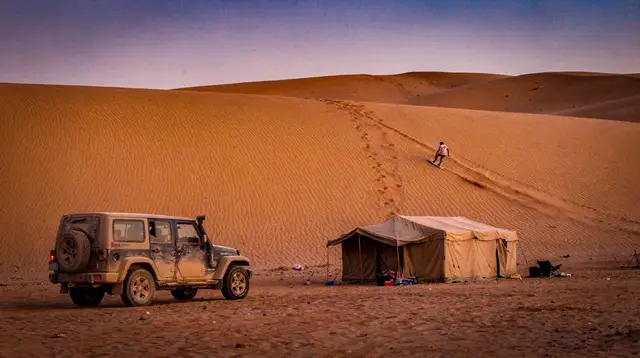
Spring is a transition. Early March can still feel close to winter comfort; by late May, afternoons are pushing toward summer numbers. The one thing worth flagging without over-explaining it here: this window carries the seasonal risk of the khamsin, a wind that can carry blowing sand and reduce visibility, typically somewhere between March and May. It is not a constant feature of spring, and most spring trips see no khamsin activity at all — but it is worth a glance at conditions if your dates land in this stretch, particularly around desert excursions like a White Desert camping trip or a Fayoum oasis day. For the specifics on what a khamsin actually looks like and how to plan around one, Cairo in spring and the khamsin covers it in full; this page only flags that the window exists.
One thing worth knowing before it happens rather than during: a khamsin does not always look dramatic. It often shows up as a hazy, sand-tinted sky that dulls photos of the pyramids or the Nile rather than an obvious storm rolling in, and visitors sometimes mistake it for pollution or an unlucky overcast day rather than recognizing it as a named weather event. It usually passes within a day or two and does not typically shut down sightseeing outright, though visibility from a viewpoint or a rooftop terrace can be noticeably reduced while it lasts.
Summer (roughly June–August): heat management, not a season to avoid
Summer is not a reason to skip Cairo, but it is a reason to restructure the day. Afternoon temperatures regularly clear 35°C, and the difference between an 8 a.m. arrival at Giza and a midday one is significant — shade is scarce on the plateau, and the walk between the pyramids and the Sphinx has no cover. The practical pattern that works: outdoor sites at opening, air-conditioned time — the Grand Egyptian Museum, the Egyptian Museum at Tahrir, a covered market stretch of Khan el-Khalili — through the hottest hours, and outdoor or waterfront time again once the sun drops. A Cairo food tour timed for evening turns the heat into a non-issue rather than an obstacle, since most of an evening food route runs after the day’s peak temperature has passed.
The trade-offs run the other way too: fewer crowds at major sites, and hotel rates that are usually lower than the winter peak. For the full detail on making summer work rather than just enduring it, see Cairo in summer.
Autumn (roughly September–November): the quiet comfortable stretch
September carries real heat, closer to summer than winter, but it eases through October, and by November the climate has settled back into the same comfortable range as the winter months, generally without winter’s crowd levels or booking pressure. Late October through November is, for visitors who cannot travel over the December–February peak, arguably the best-value window on the calendar: comfortable daytime temperatures, cooler but not yet cold mornings, and a lighter crowd at Giza, Saqqara, and the museums than the following few months will bring.
Building a trip around the calendar, not against it
Where the weather lands should shape how much you try to fit in, not just when you fly. In the cool season, a longer, denser itinerary is realistic — a multi-day route covering Cairo, Giza, and a day trip or two holds up well when temperatures stay mild from morning to evening, which is where a five-day Cairo tour or a four-day Cairo break earns its pace. In peak summer heat, the same density works better compressed around cooler hours — a tighter, well-sequenced three-day Cairo highlights route that front-loads outdoor sites into early mornings gets more done with less strain than trying to stretch the same ground over a slower week in 38°C afternoons. For general pacing questions beyond the weather angle, how many days in Cairo and three days in Cairo go into scheduling in more depth.
Two other calendar factors sit alongside temperature and are worth checking against your dates: Friday is the weekly rest day, which shifts some opening patterns, and hours change during Ramadan — see visiting Cairo during Ramadan if your trip overlaps with it. Neither is a weather issue, but both interact with how a day actually unfolds, in any season. And whatever month you land in, pace yourself against the heat rather than the clock — Cairo traffic and realistic travel times and heat survival tips for Cairo both cover the practical side of that, and if your trip lands in the khamsin window, what to know about sandstorm season is worth a read before you finalize plans. For packing that matches whichever season you land in, see what to pack for Cairo.
Cairo weather FAQ: dates, heat, and rain
What is the best month to visit Cairo?
November through March gives the most reliable comfort, with daytime highs around 20°C and cool evenings. December and January are the coolest and busiest; shoulder months like October and April trade a little extra heat for smaller crowds.
Does it ever rain in Cairo?
Rarely. Cairo sits in a hot desert climate, and rainfall is close to zero in every month. A light winter shower is possible but not something to plan around, and you will not need rain gear for a typical trip.
How hot does Cairo get in summer?
June through August often push past 35°C by early afternoon, with little relief after dark near the city center. Outdoor sites like the Giza plateau and Saqqara are far more manageable at opening time than at midday.
What is the khamsin and when does it happen?
The khamsin is a seasonal wind that can carry blowing sand and dust, mainly between March and May. It is not constant through spring, but it is worth checking conditions if your trip falls in that window.
Is winter in Cairo cold?
Not cold by European or North American standards, but cooler than visitors expect. Daytime highs sit around 20°C in December and January, while mornings and nights can feel genuinely chilly, especially near the Nile or out at Giza before sunrise.
Is Cairo humid?
Cairo is a dry desert city, not a humid one. Humidity is low most of the year, which makes the summer heat easier to take than a humid climate at the same temperature, though it also means the air dries you out faster.
Do sightseeing hours change with the seasons?
Site opening times stay broadly similar year-round, but what changes is how comfortable those hours are. In summer, arriving at opening is the difference between a manageable visit and a rough one; in winter, midday is fine at most outdoor sites.
Should I drink tap water in Cairo?
No. Stick to bottled water for drinking, even in hotels that filter their own supply, and check that bottle seals are intact when buying from street vendors. Ice in reputable hotels and restaurants is generally made from filtered water, but tap water itself is not worth the risk on a short visit.
Does Cairo observe daylight saving time?
Yes, as of 2023, after a long stretch without it. Clocks run on UTC+2 for part of the year and UTC+3 during daylight saving, so it is worth double-checking the current offset close to your travel dates rather than assuming the timezone from an earlier trip.
Best season for Cairo and Egypt tours on GetYourGuide
Verified deep-linked GetYourGuide tours. Book through these links and we earn a small commission at no cost to you.
GetYourGuide does not provide a product photo for this activity — the image shows the meeting point, photographed by us.