Camel vs horse vs quad bike at Giza
Should you see the Giza pyramids by camel, horse or quad bike?
Camels suit a slow, photogenic ride to the panoramic viewpoint and work well for families and first-timers. Horses cover the same ground faster and suit riders who already have some experience in the saddle. Quad bikes trade the animals for engine noise and speed and suit visitors who want a short adrenaline detour into the surrounding desert rather than a contemplative ride. All three are arranged on the spot at Giza, and the asking price is always negotiable before you get on.
At the Giza plateau, the pyramids and the Great Sphinx are seen on foot, but the ground between the monuments and the panoramic viewpoint above them is also worked by camel handlers, horse stables and quad bike operators. All three offer roughly the same thing — a ride out from the ticket gates toward the viewpoint that frames all three pyramids together — but the pace, the cost, the physical demand and the commercial pressure differ enough that picking the wrong one can sour an otherwise good morning. This page compares the three modes of transport around Giza. For the monuments themselves, see the separate guides to the Great Pyramid of Khufu, the pyramids of Khafre and Menkaure and the Great Sphinx.
Three ways to cover the same ground
A camel, a horse or a quad bike solves the same practical problem: the panoramic viewpoint that shows all three Giza pyramids in one frame sits some distance from the main ticket gates, across open sand, and walking it in the heat with no shade is unappealing to most visitors. Handlers and operators cluster near the entrances and approach visitors directly, often before they have even reached the ticket booths. None of these rides are run by the site itself — they are independent local businesses operating on the plateau, which is exactly why prices are not fixed and negotiation is expected.
It is worth being clear about what these rides are not. They are not a way into the pyramids or the Sphinx enclosure — entry to the monuments themselves is on foot and ticketed separately. They are a way to cover the open desert terrain around the plateau, mostly for photographs and for the experience of riding rather than for access to anything otherwise unreachable.
Camel rides: the slow, photogenic option
A camel ride at Giza moves at a walking pace, led by a handler on foot or on a second animal. It suits people who want a calm, steady ride rather than a physical challenge, and it photographs well — the raised vantage point of a camel’s back, with the pyramids behind, is the classic Giza souvenir shot. A short loop to the viewpoint typically runs 20-30 minutes; a longer route further into the desert can run an hour or more if that is agreed in advance.
Camels are generally the most forgiving option for people with no riding experience, for older visitors, and for families with children who can sit in front of an adult or ride a smaller animal led on a short lead. The trade-off is pace: a camel ride is slow, and an hour on one is a longer physical commitment for the lower back and hips than the same time on a horse.
Horse rides: faster, more physical
Horse rides cover the same routes at a faster pace, from a walk up to a trot or a controlled canter on longer sections of open sand. This suits visitors who have ridden before and want more movement and less of a purely photographic ride. Stables around Giza vary in the quality of tack and the condition of the horses, so a rushed decision at the gate is the main risk here rather than at any other point in the visit.
A horse ride generally demands more balance and some prior comfort in the saddle. It is not the best first choice for young children or for anyone unsteady on an animal, though a slow, short loop is usually available on request. As with camels, the loop to the viewpoint runs roughly 20-30 minutes at a walk, longer if trotting or cantering sections are included and agreed beforehand.
Quad bikes: speed over atmosphere
A quad bike swaps the animal for an engine and trades the slow, photogenic pace of a camel or horse for noise, dust and a short burst of speed into the desert beyond the plateau. Operators typically run guided groups with a lead rider setting the pace, and sessions are usually shorter than the animal rides — often 30-45 minutes including a safety briefing.
Quad bikes suit visitors after a quick adrenaline detour rather than a contemplative ride past the monuments, and they are a reasonable option for anyone who finds sitting on an animal uncomfortable or is short on time. They are less suited to young children, to anyone unsteady on two wheels of any kind, and to visitors mainly after photographs — the pace and the dust make it a harder ride to shoot well from.
Duration, pace and typical fit
| Option | Typical pace | Typical duration | Best suited to |
|---|---|---|---|
| Camel | Slow, walking pace | 20-30 min (longer routes available) | First-timers, families with young children, photographers |
| Horse | Walk to trot or controlled canter | 20-30 min (longer with faster sections) | Visitors with some riding experience, a faster ride |
| Quad bike | Engine-driven, short bursts of speed | 30-45 min including briefing | Visitors after a quick adrenaline detour, less concerned with photos |
Treat the durations in this table as a starting point for the conversation with a handler or operator, not as a fixed offer — always confirm the route and the time before agreeing on a price.
Negotiating the price before you mount
None of these rides have a posted, fixed price. What a handler first quotes is a starting point for negotiation, and the honest approach is the same for all three:
- Agree on the exact route, the duration and the return point before getting on the animal or the quad — not once the ride is underway.
- Agree on the total price in Egyptian pounds, in cash, before mounting. Fix whether it covers one person or more, and whether it includes the handler’s own tip or not.
- Be ready to walk away and compare a second or third handler nearby. Competition among operators at the gates works in the visitor’s favour if it is used.
- Keep small notes on hand. Handlers work in cash, and having the agreed amount ready avoids arguments over change at the end.
The mid-ride pressure tactic to expect
The most common complaint from visitors is not about the ride itself but about what happens partway through it: a handler stops the animal away from the entrance and asks for more money — sometimes framed as a “photo fee,” sometimes as a demand to continue the ride, sometimes simply as a higher tip — before allowing the visitor to continue or dismount. This is a known pattern around Giza, not an isolated incident, and it is easier to prevent than to resolve once it starts.
Agreeing on the full price and the exact endpoint before mounting removes most of the leverage for this tactic, because there is a clear, stated agreement to point back to. Carrying a phone with the agreed price noted, or simply being firm and calm about the original terms, works better than arguing once stopped in open sand away from the gates. For a broader look at the pressure tactics used around the site, see the guide to tourist scams to avoid at Giza and the notes on how to haggle in Cairo.
Where this applies — Giza only
Camel, horse and quad bike rides of this kind are a Giza phenomenon. They do not exist in the same form at Saqqara or Dahshur, where the step pyramid, the Bent Pyramid and the Red Pyramid are seen on foot and by car with no equivalent stables or operators at the gates. Anyone hoping to repeat the experience on a Saqqara or Dahshur day out should not expect the same set-up — it is specific to the Giza plateau’s tourist infrastructure, not something that follows the pyramids in general. See the comparison of Giza against Saqqara for how the two sites differ more broadly.
Fitting a ride into a Giza visit
A camel, horse or quad detour adds roughly half an hour to an hour to a Giza visit, on top of time spent at the self-guided visit of the plateau itself and any stop at the sound and light show in the evening. Anyone planning a first visit to Cairo and Giza together can see how this slots into a wider day in the one-day Cairo itinerary, and families weighing whether to include the rides at all can check the notes on Giza with kids or the general Giza accessibility guide before deciding.
Transport to the plateau itself — from a Cairo or Giza hotel, by private driver, taxi or ride-hailing app — is covered separately in the guide to getting to the Giza pyramids; none of that applies to the camel, horse or quad question, which only starts once inside the site.
Booking a fixed-price alternative
Visitors who would rather avoid negotiating with a handler at the gate altogether can look at a guided Giza pyramids tour or a dedicated camel and horse ride guide and quad bike tour, where the price is agreed in advance as part of a package rather than negotiated on the sand. It is not the only route to Giza, though — a wider Cairo booking can be paired with the plateau visit too.
An evening Cairo by night tour works well after a daytime Giza visit if the rides have already eaten into the afternoon, while a small-group off-the-beaten-path Cairo outing is a way to see more of the city once the plateau is done. Visitors who prefer a private, less scripted day can look at a Cairo insider’s tour built around personal interests rather than a fixed group route, and photographers keen to capture the pyramids properly, without the dust of a quad ride or the movement of an animal, might add a dedicated Cairo photo session either at Giza or elsewhere in the city.
Camel, horse and quad bike questions at Giza
Can you do a camel or horse ride at Saqqara or Dahshur instead of Giza?
No. The stables and handlers that offer these rides work the Giza plateau only. Saqqara and Dahshur are visited on foot and by car, with no equivalent set-up.
Do I need to book a camel or horse ride in advance?
Most riders arrange one on the spot with a handler at Giza. A fixed-price guided tour that includes the ride removes the on-the-spot negotiation, which is the main appeal of booking ahead.
How long does a typical ride last?
Handlers usually offer a short loop of around 20-30 minutes to the panoramic viewpoint, or a longer ride of an hour or more further into the desert. Confirm the duration and the route before you agree to a price.
Is a quad bike ride safe for beginners at Giza?
Operators typically give a short briefing and lead the group at a controlled pace, but the terrain is loose sand and other riders are nearby. Anyone unsteady on two wheels of any kind should ask for a slower group or skip it.
Why do handlers ask for money again partway through the ride?
It is a common pressure tactic: a handler stops the animal partway through and asks for an extra tip or a higher fee to continue or to get off. Agreeing on the full price, the duration and the return point before mounting is the main way to avoid this.
Are camel, horse and quad rides suitable for young children?
A short, slow camel ride with an adult alongside is usually the most manageable option for young children. Horses and quad bikes generally suit older children and adults with some coordination and confidence.
Do these rides go inside the pyramids or up to the Sphinx enclosure?
No. They circle the plateau and stop at viewpoints overlooking the pyramids from outside the ticketed enclosures. Entering the pyramids or the Sphinx enclosure is done on foot, separately.
Is cash needed for these rides?
Yes. Handlers work in cash, usually in Egyptian pounds, and having the agreed amount in small notes avoids disputes over change at the end of the ride.
Compare Cairo excursions and tours on GetYourGuide
Verified deep-linked GetYourGuide tours. Book through these links and we earn a small commission at no cost to you.
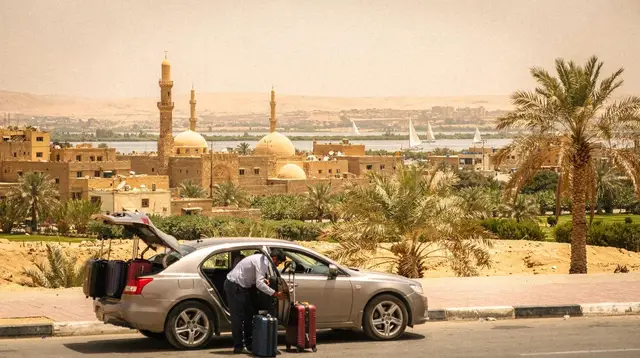
GetYourGuide does not provide a product photo for this activity — the image shows the meeting point, photographed by us.