Things to do in Giza: pyramids, Sphinx and the GEM
What can you realistically see in Giza in one day?
The three pyramids of Khufu, Khafre and Menkaure, the Great Sphinx, and the Grand Egyptian Museum fit into one day from a Cairo or Giza hotel. Adding Saqqara the same day is possible but tight, and most visitors get more out of splitting it across two outings.
Why most first trips to Egypt start here
Ask why someone booked a flight to Egypt, and the honest answer is usually Giza. The Giza plateau holds the last surviving wonder of the ancient world, and it is close enough to a Cairo or Giza hotel that it can anchor a full day without an overnight trip. This page stays on the plateau and its immediate surroundings — for the rest of the capital, see things to do in Cairo instead.
The short version: three pyramids, one Sphinx, an evening show if you want it, and a museum next door that is now the main reason to add a second stop to the same visit. What Giza does not include is Saqqara. The two get grouped together in a lot of itineraries sold online, but they sit far enough apart, and each takes long enough on its own, that combining them turns a solid day into a rushed one.
The three pyramids and the Great Sphinx
The plateau holds three pyramids, not two or four: the Pyramid of Khufu (the Great Pyramid, the only one of the seven ancient wonders still standing), the Pyramid of Khafre, and the smaller Pyramid of Menkaure. Below them, facing east, is the Great Sphinx. All four monuments, along with the rest of the pyramid fields down to Dahshur, form a single UNESCO World Heritage site inscribed in 1979 as Memphis and its Necropolis.
A visit typically covers the exterior of all three pyramids, a Sphinx viewpoint, and — for those who want it — entry inside one of the pyramids, usually Khufu’s, sold as a separate ticket. Details on that experience, and on each pyramid individually, are covered in the Great Pyramid of Khufu guide, the Great Sphinx guide and the guide to Khafre and Menkaure. If you would rather see the plateau at your own pace with a private guide, that option and its logistics are laid out in the self-guided visit of the Giza plateau.
a combined Giza pyramids and Egyptian Museum day covers the plateau in the morning and the museum collection afterward, which is the most common way visitors structure this day.
The Grand Egyptian Museum, next door
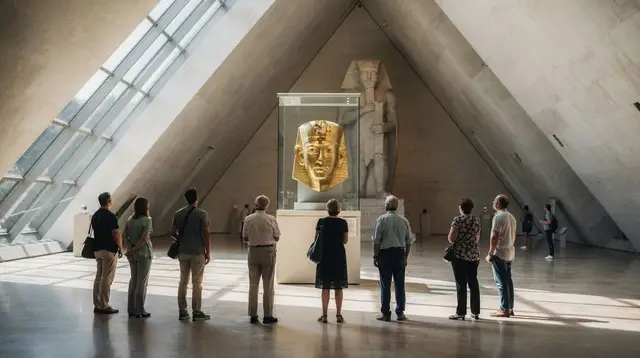
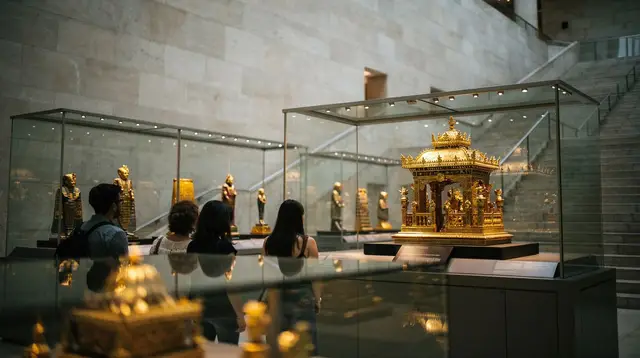
The Grand Egyptian Museum sits close to the plateau and was officially inaugurated on 1 November 2025, after years of delays. It now holds the complete Tutankhamun collection, displayed together for the first time, along with thousands of other pieces previously in storage or scattered across smaller museums. This is genuinely new, not a soft opening or a partial one — plan for it as a full stop on its own, not a quick add-on.
A common point of confusion: the Egyptian Museum on Tahrir Square, open since 1902, has not closed. It still holds a large collection, including pieces that were never moved to the GEM. The two museums coexist; neither has replaced the other. For a side-by-side comparison of what each one holds and which suits a given trip, see Grand Egyptian Museum versus the Egyptian Museum in Tahrir. Full detail on the new museum’s layout and Tutankhamun galleries is in the Grand Egyptian Museum guide and the Tutankhamun collection guide; Tahrir’s own collection is covered in the Egyptian Museum, Tahrir guide.
One more thing the GEM does not have: the royal mummies. Those moved to the National Museum of Egyptian Civilization in Fustat after the April 2021 Pharaohs’ Golden Parade, and they stay there — not at the GEM, and not at Tahrir.
Pyramids plus GEM: realistic. Pyramids plus Saqqara: usually not
Pairing the Giza plateau with the Grand Egyptian Museum on the same day works because they are next to each other — a short drive, not a route through Cairo traffic. Most visitors can do a morning at the pyramids and Sphinx, then move to the museum for the afternoon or evening, since the GEM’s collection is large enough to fill several hours on its own.
Saqqara is a different case. It is a genuine half-day or full-day site in its own right, home to the Step Pyramid of Djoser and, further on, Dahshur’s Bent and Red Pyramids and the Ramesses II colossus at Memphis. Doing Giza and Saqqara together is physically possible with a private driver and an early start, but it compresses two substantial sites into one long day, usually at the cost of rushing both. This page does not walk through that combined itinerary — for the full case, see Saqqara, Dahshur and Memphis tours and the direct comparison in Giza versus Saqqara.
Sound and light show in the evening
Giza runs an evening sound and light show at the plateau, projected onto the pyramids and the Sphinx after dark. It gives a reason to be back at Giza once the daytime heat and crowds have thinned, and it is a different experience from a daytime visit rather than a substitute for one — you will not see the monuments’ stonework or scale up close at night the way you do in daylight. Details on scheduling and what to expect are in the Giza sound and light show guide.
an evening sound and light show at the Giza pyramids is a straightforward way to book a fixed seat rather than arranging transport twice in one day.
Getting to Giza and timing your day
Whether you are staying in central Cairo, Zamalek, Garden City, Heliopolis or a hotel on the Giza side facing the plateau changes how your day starts. From most central Cairo hotels, allow 45 to 90 minutes to reach the plateau, depending on traffic, which stays heavy through most of the day rather than clearing at a predictable hour. Staying in Giza itself cuts that leg down to a short ride, which matters if you want to be at the gates near opening time before the heat and the tour buses build up.
Coming straight from the airport, Cairo International Airport (CAI) sits in Heliopolis, northeast of the centre, and the drive to Giza runs 60 to 90 minutes depending on traffic. Sphinx International (SPX), west of Giza, handles far fewer flights but sits closer to the plateau when it is an option. A private driver is the norm for this kind of day, and Uber and Careem both operate widely in Cairo if you would rather book rides individually. More on getting specifically to the plateau is in how to get to the Giza pyramids, and on Cairo’s traffic patterns generally in Cairo traffic and realistic travel times.
| Starting point | Typical drive to Giza plateau |
|---|---|
| Central Cairo hotel | 45–90 minutes |
| Zamalek or Garden City | 45–90 minutes |
| Heliopolis | 60–90 minutes |
| Cairo International Airport (CAI) | 60–90 minutes |
| Giza hotel near the plateau | Under 20 minutes |
Best time to arrive, and what the crowds look like
Gates typically open early, and the plateau fills fastest between roughly 9am and 1pm, once tour buses from the big Cairo hotels arrive in numbers and the day’s heat starts building. Turning up at opening time buys two things: cooler air for the walk between the pyramids, and a window before the largest tour groups converge on the same viewpoints near the Sphinx. Afternoon light is often better for photographs of the pyramids themselves, since the sun sits behind the monuments in the morning, but that trade-off comes with more people in the frame and a hotter walk across open sand.
Friday mornings run on a different rhythm than the rest of the week, since it is the day of rest in Cairo, and site hours can shift again during Ramadan — check the current schedule rather than assuming a fixed opening time. Whichever slot you pick, water matters more here than it sounds: there is little shade on the plateau itself, and the walk between the pyramids and the Sphinx viewpoint is longer, and hotter, than it looks from a hotel room photo.
Extra ways to see the plateau
Beyond the standard pyramids-and-Sphinx visit, a few add-ons come up often enough to mention here, without turning this page into a full activity list:
- A short camel or horse ride around the plateau’s edges, usually booked on site or added to a guided tour.
- A paramotor flight or similar aerial view over the pyramids for visitors who want the site from above rather than on foot.
- A private Egyptologist guide, which tends to make more difference at Giza than at smaller sites, given how much context the plateau’s layout leaves unexplained without one.
a private half-day tour of the Giza pyramids is the more flexible option if you would rather set your own pace than join a fixed group.
Accessibility on the plateau
The ground at Giza is a genuine obstacle for visitors with limited mobility: uneven stone, loose sand and gravel paths connect the ticket area, the viewpoints and the Sphinx enclosure, and there is no paved route between them. Wheelchairs can manage some of the site with assistance, particularly the main viewpoints reached by vehicle, but getting close to the Sphinx or walking the full loop between the three pyramids on foot is difficult without help. Vehicles are allowed to drive partway into the site along a fixed route, which is the practical option for anyone who cannot manage a long walk on sand, and it is worth arranging in advance rather than discovering the limits on arrival. There are few benches and little shade, so visitors who tire easily are better served by a shorter, vehicle-based loop than by attempting the same ground-level route as a fully able visitor.
What tends to disappoint
A few things surprise first-time visitors, and it is worth saying them plainly rather than glossing over them. Touts around the plateau’s edges are persistent — offers of camel rides, guiding, or a photo op appear before you have parked, and prices quoted on the spot are rarely the final ones without negotiation. The area immediately around the ticket gates and between the monuments has grown around tourism to the point that souvenir stalls and photo-op operators crowd the view in places, which does not match the empty-desert image sold in most photographs.
The city itself is also closer than many people expect: parts of Giza’s urban sprawl sit right up against the site boundary, and skyline and traffic noise are visible and audible from several viewpoints on the plateau, not just from a distance. None of this makes the site not worth the visit — the monuments hold up on their own — but arriving with the desert-postcard image intact is a common source of disappointment that a bit of warning fixes in advance.
Common mix-ups worth avoiding
A few confusions come up often enough with Giza specifically that they are worth stating plainly:
- Giza has three pyramids — Khufu, Khafre and Menkaure — not two, and not four.
- The Step Pyramid of Djoser belongs to Saqqara, not Giza. Don’t expect to see it on a standard Giza day.
- The Bent Pyramid and Red Pyramid are at Dahshur, a separate site again, further south still.
- The GEM opened officially on 1 November 2025. It is not a partial or preview opening.
- The Egyptian Museum in Tahrir is still open. The GEM did not replace it.
- The royal mummies are at the National Museum of Egyptian Civilization in Fustat, not at the GEM and not at Tahrir.
- Hot air balloons fly over Luxor’s west bank, not over Giza or Cairo — don’t expect one here.
If you are weighing Giza against a wider first look at the capital, things to do in Cairo covers the rest of the city, and a one-day Cairo itinerary shows how a Giza morning fits into a single-day plan alongside other stops. For booking the day itself, a Giza pyramids and national museum tour is another route to the same pyramids-and-museum combination described above.
Giza questions, answered
Can you see the pyramids and the Grand Egyptian Museum in one day?
Yes. The GEM sits right next to the Giza plateau, so a pyramids-plus-museum day is a realistic plan. Start early at the plateau, then move to the museum in the afternoon or evening, since the collection alone can take several hours.
Is the Egyptian Museum in Tahrir still open now that the GEM has opened?
Yes. The Egyptian Museum on Tahrir Square, open since 1902, has not closed. The GEM, officially inaugurated on 1 November 2025, is a separate museum with the complete Tutankhamun collection; Tahrir still holds a large collection of its own.
Can you visit Giza and Saqqara on the same day?
It is possible in a private car with an early start, but it makes for a long, rushed day. Most visitors are better served treating Giza as its own day and covering Saqqara, Dahshur and Memphis separately.
How long does it take to get from central Cairo to the Giza pyramids?
Plan on 45 to 90 minutes depending on traffic, which is heavy through most of the day. From Cairo International Airport, allow 60 to 90 minutes to reach Giza.
Is the sound and light show at Giza worth doing?
It gives you an evening reason to be back at the plateau and a different view of the pyramids after dark. It works best paired with a daytime visit rather than as a replacement for one, since you will not see the monuments’ detail at night.
Where are the royal mummies now that they are not in the Tahrir museum?
The royal mummies moved to the National Museum of Egyptian Civilization in Fustat after the April 2021 Pharaohs’ Golden Parade. They are not part of the Giza or GEM visit.
Do the Giza pyramids have a step pyramid?
No. The Step Pyramid of Djoser is at Saqqara, a separate site south of Giza. Giza has the three true pyramids of Khufu, Khafre and Menkaure plus the Great Sphinx.
What time should you arrive at Giza to beat the crowds?
Arriving at opening time gives the coolest temperatures and the fewest tour groups; the plateau fills up fastest between roughly 9am and 1pm once buses from central Cairo hotels arrive. Afternoon light suits photography better but comes with denser crowds.
Is the Giza plateau accessible for visitors with limited mobility?
Only partly. Paths between the pyramids and the Sphinx are uneven sand and gravel with no paved route, though vehicles can drive partway into the site along a fixed route for those who cannot manage the walk on foot. Arranging vehicle access in advance is more reliable than expecting to manage it on arrival.
Cairo trip planning and itinerary tours on GetYourGuide
Verified deep-linked GetYourGuide tours. Book through these links and we earn a small commission at no cost to you.
GetYourGuide does not provide a product photo for this activity — the image shows the meeting point, photographed by us.